
Palmitoyl Tetrapeptide-7 (Rigin) (CAS 221227-05-0) is supplied by TCS NEXUS S.L. (Valencia, Spain) for European cosmetic formulators, brand R&D teams and B2B buyers reviewing cosmetic peptide raw material applications. With limited direct water solubility, it requires propylene glycol or ethanol pre-dispersion before aqueous dilution, at pH 4.5–7.0, with incorporation below 40°C in standard emulsion manufacturing protocols.
> Technical Specifications
| Product Name | Palmitoyl Tetrapeptide-7 (Rigin) |
|---|---|
| Molecular Structure | 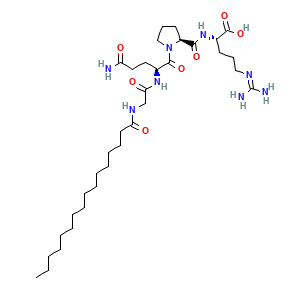 |
| CAS Number | 221227-05-0 |
| Alias / Common Name | Palmitoyl Tetrapeptide-7; Rigin; N-Palmitoyl Rigin; Palmitoyl-GQPR; Pal-Gly-Gln-Pro-Arg |
| Molecular Formula | C34H62N8O7 |
| Molecular Weight | 694.9 g/mol |
| INCI Name | Palmitoyl Tetrapeptide-7 |
| Peptide Sequence | Palmitoyl-Gly-Gln-Pro-Arg — IgG C-terminal Fc sequence biomimetic (NF-κB / IL-6 / TNF-α pathway) |
| Functional Class | Synthetic lipopeptide; IL-6/TNF-α modulator; soothing matrix-care active |
| Purity / Assay | ≥98% (HPLC); confirm by batch COA |
| Appearance | White to off-white powder |
| Solubility / Handling | Limited direct water solubility; pre-disperse in propylene glycol or low-concentration ethanol (10–30%) before aqueous dilution; confirm clarity in the target emulsion or serum base |
| pH Stability | Optimal stability at pH 4.5–7.0; confirm in target emulsion base after all actives incorporated |
| Storage | Store sealed in cool, dry conditions protected from direct light and moisture; follow batch COA and SDS |
> Mechanism & Positioning
Palmitoyl Tetrapeptide-7 (Rigin, CAS 221227-05-0) is a palmitoyl-lipidated tetrapeptide with the sequence Gly-Gln-Pro-Arg, derived from the C-terminal region of the IgG Fc fragment, designed to modulate inflammatory signalling pathways in skin. Published Palmitoyl Tetrapeptide-7 literature discusses that the Gly-Gln-Pro-Arg sequence interacts with IL-1β receptor-associated signalling cascades, modulating NF-κB pathway activation and reducing production of pro-inflammatory cytokines including interleukin-6 (IL-6) and tumour necrosis factor alpha (TNF-α) in dermal fibroblast and keratinocyte systems. Cell-based studies document suppression of UV-induced IL-6 release in keratinocyte assays and modulation of inflammatory mediator output in fibroblast models, consistent with soothing matrix-protective positioning. Cytokine model data also notes modulation of IL-1β-induced inflammatory cascades in dermal cell assays at concentrations used in cosmetic evaluation protocols, supporting UV-post-conditioning and chronic inflammatory skin positioning.
Based on available in vitro data, Palmitoyl Tetrapeptide-7 is positioned for soothing matrix-care, UV-post-conditioning and advanced age-care emulsion concepts where NF-κB / IL-6 / TNF-α pathway modulation is the primary mechanistic direction. The calming lipopeptide mechanism complements the TGF-β1 matrix synthesis pathway of Palmitoyl Tripeptide-1 (Pal-GHK) — together forming the dual-active combination known as Matrixyl 3000 — and the fibronectin-receptor/TGF-β signalling of Matrixyl (Palmitoyl Pentapeptide-4/3), enabling simultaneous matrix synthesis support and inflammatory pathway modulation in a premium multi-active age-care concentrate.
> Application Concepts
Calming Age-Care Emulsion Architecture
Palmitoyl Tetrapeptide-7 has limited direct water solubility due to the palmitoyl fatty acid chain — pre-disperse in propylene glycol (5–15% w/w) or low-concentration ethanol (10–20%) at ambient temperature before incorporating into the aqueous or emulsion phase at evaluation concentrations of 10–1000 ppm (0.001–0.1% w/w). Introduce during the warm aqueous phase (below 40°C) or cool-down phase after PG pre-dispersion; avoid temperatures above 45°C. The lipopeptide integrates into standard o/w emulsions, cream-gel bases and serum-emulsion hybrids without special emulsifier systems for the peptide. For combined IL-6/TNF-α calming and TGF-β1 matrix synthesis positioning, Palmitoyl Tetrapeptide-7 may be combined with Palmitoyl Tripeptide-1 (Pal-GHK) — the Matrixyl 3000 combination. Confirm emulsion stability and combined assay retention via accelerated testing at 40°C/75% RH before scale-up.
Matrixyl 3000 Combination and Multi-Active Matrix Systems
Palmitoyl Tetrapeptide-7 (Pal-GQPR) is the calming component of the Matrixyl 3000 combination (Pal-GHK + Pal-GQPR). Palmitoyl Tripeptide-1 (Pal-GHK) activates TGF-β1-mediated collagen I/III synthesis via fibronectin-receptor signalling; Palmitoyl Tetrapeptide-7 (Pal-GQPR) modulates NF-κB pathway IL-6 and TNF-α signalling — addressing chronic inflammatory ECM degradation through a distinct calming mechanism. Both lipopeptides require propylene glycol or ethanol pre-dispersion and are incorporated in the same formulation phase at the same addition temperature below 40°C, making the combination straightforward from a manufacturing protocol perspective. For broader calming matrix positioning, Palmitoyl Tetrapeptide-7 may also be combined with Ectoin for complementary extremolyte-based inflammation modulation. Confirm combined PG premix compatibility and emulsion stability before committing to production scale.
UV-Post-Conditioning and Sensitive-Skin Formulations
The IL-6 and TNF-α modulating activity of Palmitoyl Tetrapeptide-7 makes it particularly relevant for UV-post-conditioning treatments and sensitive-skin formulations where reduction of UV-induced inflammatory cytokine release is a formulation target alongside matrix-repair positioning. At 10–1000 ppm, it integrates into soothing emulsions, calming gel-creams and sensitive-skin serums alongside established soothing actives such as panthenol (1–3%), bisabolol (0.1–0.5%) and niacinamide (2–5%). Confirm pH alignment across all actives within 4.5–7.0; evaluate propylene glycol compatibility with the overall formulation sensory profile and regulatory brief. Run accelerated stability testing at 40°C/75% RH and confirm assay retention and emulsion stability across the full shelf-life period before scale-up.
> Handling & Formulation Notes
Palmitoyl Tetrapeptide-7 has limited direct water solubility due to the C16 palmitoyl fatty acid chain — pre-disperse in propylene glycol (5–15% w/w) or low-concentration ethanol (10–20%) at ambient temperature before diluting into the aqueous or emulsion phase. Incorporate the premix during the warm phase below 40°C or during cool-down; avoid temperatures above 45°C. Maintain formulation pH within 4.5–7.0; confirm pH after all actives are incorporated.
Evaluate compatibility with EDTA-containing preservative systems and strongly acidic actives at pH below 4.0. Confirm appearance, clarity, emulsion stability and lipopeptide assay retention via accelerated stability testing at 40°C/75% RH across the intended shelf-life period before scale-up. Where propylene glycol is restricted, evaluate alternative lipidic carrier or microemulsion strategies for pre-dispersion.
> Supply & Documentation
Palmitoyl Tetrapeptide-7 (Rigin) (CAS 221227-05-0) is available from TCS NEXUS S.L. (Valencia, Spain) for B2B cosmetic raw material projects. Standard documentation: COA, TDS, SDS. Sample and bulk quantities are discussed on a per-project basis; contact info@tcspeptides.com to initiate a sourcing review.
TCS NEXUS S.L. supports procurement and formulation teams in Germany, France, Italy, Spain, the United Kingdom, the Netherlands, Belgium, Poland, Sweden and Portugal, as well as international buyers in the United States, Canada, Japan, South Korea, Australia and New Zealand.
> Packaging & Storage
Palmitoyl Tetrapeptide-7 (Rigin) is supplied in sealed aluminium foil bags or bulk containers. Minimum quantities and packaging configurations are confirmed per order. Store below 25°C in a cool, dry location, away from moisture and direct light. Follow batch COA and SDS for specific storage and handling conditions.
> FAQ
What is Palmitoyl Tetrapeptide-7 (Rigin)?
Palmitoyl Tetrapeptide-7 (Rigin) (CAS 221227-05-0) is a cosmetic raw material supplied by TCS NEXUS S.L. (Valencia, Spain) for B2B cosmetic formulators. In cosmetic literature, Palmitoyl Tetrapeptide-7 (Rigin) is positioned as an immunomodulatory lipopeptide targeting IL-6-driven skin inflammageing — evaluated in anti-ageing serums, mature-skin formulations and as the calming partner in Matrixyl Synthe’6. TCS NEXUS S.L. supplies Palmitoyl Tetrapeptide-7 as a B2B active for formulators developing anti-ageing emulsions and targeted treatment serums.
What is the CAS number for Palmitoyl Tetrapeptide-7 (Rigin)?
The CAS number for Palmitoyl Tetrapeptide-7 (Rigin) is 221227-05-0. The INCI name for cosmetic regulatory documentation and CPNP notification is Palmitoyl Tetrapeptide-7; confirm CAS 221227-05-0 and INCI identity against the batch COA when building product files.
How does Rigin calm inflammatory matrix damage — what is the IL-6 / TNF-α mechanism?
Palmitoyl Tetrapeptide-7 (Rigin) is a lipidated peptide whose Gly-Gln-Pro-Arg (GQPR) sequence is biomimetic of the C-terminal Fc region of immunoglobulin G. It works through the NF-κB pathway to temper excess production of pro-inflammatory cytokines — notably interleukin-6 (IL-6) and TNF-α — that drive inflammaging and glycation-related matrix breakdown. This soothing, anti-inflammatory action positions it for redness-prone and mature-skin age-care rather than direct collagen stimulation.
What use level of Rigin is typical, and does the pure vs trade-solution basis matter?
Because the effective level shifts with formulation, claim and protocol, evaluate it conservatively and confirm it in your own trials rather than assuming a fixed figure. Palmitoyl Tetrapeptide-7 reaches the market both as a diluted trade solution and as pure peptide; we supply the pure material with COA so you can dose precisely on a pure-peptide basis. Contact info@tcspeptides.com to align documentation with your dosing basis.
Which actives pair with Rigin, and how does it complete Matrixyl 3000?
Palmitoyl Tetrapeptide-7 is the soothing, anti-inflammatory half of Matrixyl 3000, paired there with the collagen-signalling Palmitoyl Tripeptide-1 (Pal-GHK) so that matrix synthesis and inflammatory breakdown are addressed together. Beyond that duo, Rigin layers with signal peptides such as Matrixyl (Palmitoyl Pentapeptide-4) and with calming actives such as niacinamide. Pre-disperse it before combining and confirm clarity and pH in the finished base.
How does Rigin differ from its Matrixyl 3000 partner Pal-GHK?
Both are palmitoylated matrikines used together in Matrixyl 3000, but they act on different targets. Palmitoyl Tetrapeptide-7 (Rigin) modulates inflammatory cytokines such as IL-6 and TNF-α for a soothing, anti-inflammaging effect, whereas Palmitoyl Tripeptide-1 (Pal-GHK) signals through TGF-β1/fibronectin to upregulate collagen and matrix synthesis. Combining them pairs matrix building with inflammatory calming. Both have limited water solubility and are pre-dispersed before use.
How should the lipidated Rigin be pre-dispersed and added?
The palmitoyl chain limits direct water solubility, so pre-disperse Palmitoyl Tetrapeptide-7 in a small amount of propylene glycol or 10–30% ethanol before diluting into the aqueous or emulsion phase. Introduce it during the cool-down phase below 45°C, then confirm solution clarity and finished-product pH; standard emulsion cool-down steps work well.
What pH range keeps Rigin stable in a finished emulsion?
Palmitoyl Tetrapeptide-7 is most stable at pH 4.5–7.0, in line with common serum and emulsion targets. Verify the finished-product pH once all actives and buffering agents are in, and assess combined stability where it shares a base with low-pH actives such as ascorbic acid.
What claim direction is Rigin positioned for in age-care formulas?
Its cytokine-modulating, soothing profile positions Palmitoyl Tetrapeptide-7 for anti-inflammaging, comfort and mature- or sensitive-skin age-care claim directions, frequently within a multi-matrikine system. Keep any claims within EU cosmetic limits and back them with your own in-house use and stability data.
Is Palmitoyl Tetrapeptide-7 (INCI) compliant with EU Cosmetics Regulation 1223/2009?
Palmitoyl Tetrapeptide-7 is not listed as a restricted, prohibited or regulated substance under EU Cosmetics Regulation 1223/2009 Annexes II–VI. The finished product manufacturer is responsible for the CPSR and CPNP notification. Use CAS 221227-05-0 and INCI name Palmitoyl Tetrapeptide-7 consistently in all regulatory documentation; confirm purity and identity against the batch COA.
How should Palmitoyl Tetrapeptide-7 (Rigin) be stored?
Store Palmitoyl Tetrapeptide-7 (Rigin) sealed below 25°C in a cool, dry location protected from direct light and moisture. Once opened, reseal the container immediately. Follow specific storage and handling conditions stated in the SDS and batch COA. Confirm shelf life for the specific batch before incorporating into production formulations.
What documentation does TCS NEXUS S.L. provide for Palmitoyl Tetrapeptide-7 (Rigin)?
TCS NEXUS S.L. provides COA (confirming CAS 221227-05-0 and HPLC purity ≥98% (HPLC)), TDS (Technical Data Sheet) and SDS (Safety Data Sheet) for Palmitoyl Tetrapeptide-7 (Rigin). Additional documentation such as specification sheets and INCI confirmation letters is available on a per-project basis. Contact info@tcspeptides.com to initiate a documentation and sourcing discussion.
What MOQ and sample options are available for Palmitoyl Tetrapeptide-7 (Rigin)?
Sample and bulk quantities for Palmitoyl Tetrapeptide-7 (Rigin) are confirmed on a per-project basis through TCS NEXUS S.L. Minimum order quantities depend on current stock, packaging configuration and project scope. R&D teams are encouraged to request samples for stability and concentration-range evaluation before bulk planning. Contact info@tcspeptides.com with project specification to begin a sourcing review.
> Technical Support and Samples
Request COA documents, sample availability, or support for custom synthesis.