
Tripeptide-10 Citrulline (Decorinyl) (CAS 960531-53-7) is supplied by TCS NEXUS S.L. (Valencia, Spain) for European cosmetic formulators, brand R&D teams and B2B buyers reviewing cosmetic peptide raw material applications. A freely water-soluble peptide, it dissolves directly in aqueous concentrates without co-solvents at pH 5.0–7.5, with cool-down addition below 45°C recommended in standard serum and leave-on manufacturing protocols.
> Technical Specifications
| Product Name | Tripeptide-10 Citrulline (Decorinyl) |
|---|---|
| Molecular Structure | 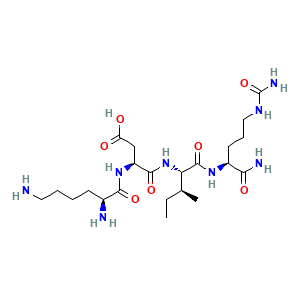 |
| CAS Number | 960531-53-7 |
| Alias / Common Name | Tripeptide-10 Citrulline; Decorinyl |
| Molecular Formula | C22H42N8O7 |
| Molecular Weight | 530.6 g/mol |
| INCI Name | Tripeptide-10 Citrulline |
| Functional Class | Synthetic citrullinated tripeptide; decorin/fibrillin biomimetic; collagen fibril diameter and organisation modulator |
| Purity / Assay | ≥98% (HPLC); confirm by batch COA |
| Appearance | White to off-white powder |
| Solubility / Handling | Freely water-soluble; dissolve in deionised water or aqueous phase at ambient temperature; no co-solvent required |
| pH Stability | Optimal stability at pH 5.0–7.5; confirm in the complete formulation after all actives |
| Storage | Store sealed below 25°C in cool, dry, light-protected conditions; follow batch COA and SDS |
> Mechanism & Positioning
Tripeptide-10 Citrulline (Decorinyl, CAS 960531-53-7) is a synthetic citrullinated tripeptide designed as a biomimetic of decorin and fibrillin-1 functional sequences, targeting the small leucine-rich proteoglycan (SLRP) decorin and fibrillin-1 microfibril pathways that regulate collagen fibril diameter uniformity, fibril spacing and lateral fibril-to-fibril organisation in the dermis. Published Tripeptide-10 Citrulline literature discusses decorin (DCN) upregulation — decorin binds to the collagen fibril surface at D-period sites, regulating fibril diameter (fine, uniform fibrils in young skin; thicker, irregular in aged skin) and fibril-to-fibril spacing via proteoglycan side-chain electrostatic repulsion. Cell-based dermal fibroblast studies document decorin gene expression modulation and associated collagen fibril diameter normalisation effects in ECM model systems. Collagen fibril organisation model data also notes fibrillin-1 microfibril pathway interaction — fibrillin-1 microfibrils serve as a scaffold for elastic fibre assembly and as a signalling platform for TGF-β latent complexes, making fibrillin modulation relevant to both ECM architecture and matrix growth factor bioavailability.
Based on available in vitro data, Tripeptide-10 Citrulline (Decorinyl) is positioned for collagen-quality serum, ECM architecture concentrate and structural anti-age emulsion concepts where decorin-pathway collagen fibril organisation is the mechanistic direction. The SLRP decorin mechanism complements and is independent from the TGF-β1 collagen synthesis pathway of Matrixyl — providing both new collagen synthesis (Matrixyl) and collagen fibril quality organisation (Decorinyl) for comprehensive ECM architecture. Further combine with GHK-Cu for LOX-mediated fibril crosslinking maturation.
> Application Concepts
Collagen Fibril Quality and ECM Architecture Serum Design
Tripeptide-10 Citrulline (Decorinyl) dissolves freely in deionised water and aqueous serum bases at 10–100 ppm without co-solvent. Introduce during the cool-down phase below 45°C; standard serum protocols are compatible. For comprehensive ECM architecture positioning — covering both new collagen synthesis and collagen fibril quality — combine Decorinyl (decorin fibril organisation) with Matrixyl (TGF-β1 new collagen synthesis), GHK-Cu (LOX crosslinking) and Hexapeptide-9 Collaxyl (collagen IV basement membrane). All four are water-soluble, pH-compatible at 5.0–7.5 and added during cool-down below 45°C in a single manufacturing step. Confirm combined assay retention via HPLC at 40°C/75% RH.
Decorin vs Lumican SLRP Pathway: Complementary Fibril Organisation
Tripeptide-10 Citrulline (Decorinyl, decorin pathway) and Acetyl Tetrapeptide-9 (Dermican, lumican pathway) both target SLRP proteoglycan pathways that regulate collagen fibril diameter and organisation, but via different SLRP family members. Decorin (DCN) and lumican (LUM) are both Class I SLRPs that bind to collagen fibril surfaces, but at different sites — decorin to the collagen D-period groove; lumican to the fibril surface via leucine-rich repeat interactions. Both independently regulate fibril diameter and ECM mechanical properties. In premium ECM architecture serums, combining Decorinyl + Dermican provides dual-SLRP collagen fibril organisation coverage across two independent proteoglycan pathways. All are water-soluble, pH-compatible at 5.0–7.5 and can be combined at their respective 10–100 ppm evaluation concentrations. Confirm combined stability before production.
Fibrillin-1 Microfibril and Elastic ECM Framework Support
The fibrillin-1 pathway interaction of Tripeptide-10 Citrulline extends its ECM positioning beyond collagen fibril quality into elastic fibre scaffold architecture — fibrillin-1 microfibrils form the scaffold on which elastin is deposited during elastic fibre assembly, and they serve as a platform for sequestered TGF-β latent complexes (via LTBP). Modulation of fibrillin-1 microfibril expression potentially supports both elastic fibre assembly and TGF-β growth factor bioavailability in the dermis. For premium ECM architecture concentrates targeting both collagen quality and elastic fibre scaffold, combine Decorinyl (decorin/fibrillin) with Biopeptide-EL (Palmitoyl Hexapeptide-12, tropoelastin/EBP receptor) for complementary ECM elastic component coverage. Confirm combined stability and assay retention before scale-up.
> Handling & Formulation Notes
Dissolve Tripeptide-10 Citrulline (Decorinyl) in deionised water or the aqueous phase at ambient temperature at 10–100 ppm without co-solvent. Freely water-soluble at evaluation concentrations. The citrulline residue is a non-standard amino acid — confirm HPLC assay method compatibility for citrulline-containing peptide quantitation in the specific stability protocol. Introduce during cool-down below 45°C. Maintain pH within 5.0–7.5.
Evaluate compatibility with preservative systems and chelating agents at typical cosmetic concentrations. Confirm citrullinated peptide assay retention by HPLC after accelerated stability at 40°C/75% RH before production scale-up.
> Supply & Documentation
Tripeptide-10 Citrulline (Decorinyl) (CAS 960531-53-7) is available from TCS NEXUS S.L. (Valencia, Spain) for B2B cosmetic raw material projects. Standard documentation: COA, TDS, SDS. Sample and bulk quantities are discussed on a per-project basis; contact info@tcspeptides.com to initiate a sourcing review.
TCS NEXUS S.L. supports procurement and formulation teams in Germany, France, Italy, Spain, the United Kingdom, the Netherlands, Belgium, Poland, Sweden and Portugal, as well as international buyers in the United States, Canada, Japan, South Korea, Australia and New Zealand.
> Packaging & Storage
Tripeptide-10 Citrulline (Decorinyl) is supplied in sealed aluminium foil bags or bulk containers. Minimum quantities and packaging configurations are confirmed per order. Store below 25°C in a cool, dry location, away from moisture and direct light. Follow batch COA and SDS for specific storage and handling conditions.
> FAQ
What is Tripeptide-10 Citrulline (Decorinyl)?
Tripeptide-10 Citrulline (Decorinyl) (CAS 960531-53-7) is a cosmetic raw material supplied by TCS NEXUS S.L. (Valencia, Spain) for B2B cosmetic formulators. In cosmetic literature, Tripeptide-10 Citrulline (Decorinyl) is positioned as a collagen fibril-organising peptide that improves dermal matrix architecture — evaluated in anti-ageing serums targeting the loss of type I collagen fibril alignment and skin firmness that occurs with chronological ageing and UV exposure. TCS NEXUS S.L. supplies Tripeptide-10 Citrulline as a B2B active for anti-ageing formulation specialists.
What is the CAS number for Tripeptide-10 Citrulline (Decorinyl)?
The CAS number for Tripeptide-10 Citrulline (Decorinyl) is 960531-53-7. The INCI name for cosmetic regulatory documentation and CPNP notification is Tripeptide-10 Citrulline; confirm CAS 960531-53-7 and INCI identity against the batch COA when building product files.
How does Decorinyl organise collagen fibrils — what is the decorin mechanism?
Tripeptide-10 Citrulline (Decorinyl) is a citrullinated tripeptide that mimics decorin, the small proteoglycan that regulates collagen fibril assembly. Rather than increasing collagen quantity, it is described as controlling collagen fibril diameter and spacing so that fibrils form in an even, well-organised network — targeting the quality and organisation of the matrix, which relates to firmness and smoothness.
What use level of Decorinyl is typical, and how should it be evaluated?
There is no one-size-fits-all dose: establish the use level conservatively for your specific base and claim. Decorinyl is often supplied as a trade solution, so confirm your dosing basis; we provide the pure material with COA. Contact info@tcspeptides.com to align documentation.
Which actives pair with Decorinyl for a build-and-organise matrix system?
Decorinyl organises fibrils, so it complements peptides that stimulate collagen synthesis — Matrixyl (Palmitoyl Pentapeptide-4), Palmitoyl Tripeptide-5 (SYN-COLL) and GHK-Cu — giving a “build and organise” pairing, and it layers with niacinamide and hydrating actives. It is water-soluble; confirm combined stability and pH in the finished base.
How does Decorinyl differ from collagen-stimulating peptides like Matrixyl?
Most matrix peptides (Matrixyl, Palmitoyl Tripeptide-5) increase collagen synthesis; Decorinyl instead regulates how the collagen that is made assembles into fibrils — controlling diameter and organisation for a smoother, more evenly structured matrix. It addresses fibril quality rather than quantity, which is why it is often paired with a synthesis-stimulating peptide. Decorinyl is freely water-soluble.
What addition temperature is recommended for Tripeptide-10 Citrulline (Decorinyl) during manufacturing?
Introduce Tripeptide-10 Citrulline (Decorinyl) during the cool-down phase at temperatures below 45°C; avoid prolonged exposure above this threshold. Standard aqueous or emulsion cool-down protocols are fully compatible with this addition requirement. Confirm thermal stability in the specific manufacturing process with accelerated stability data before committing to production scale.
What pH range keeps Decorinyl stable in a finished formula?
Tripeptide-10 Citrulline is most stable at roughly pH 4.5–7.0; confirm the finished-product pH after all actives are incorporated and evaluate combined stability with low-pH actives such as ascorbic acid.
Is Tripeptide-10 Citrulline (Decorinyl) compatible with other actives in multi-active cosmetic systems?
Tripeptide-10 Citrulline (Decorinyl) is compatible with standard cosmetic actives at pH 5.0–7.5 in aqueous or emulsion systems. Evaluate combined system pH drift, clarity and assay retention; confirm preservative compatibility. Run accelerated stability testing at 40°C/75% RH before scale-up.
Is Tripeptide-10 Citrulline (INCI) compliant with EU Cosmetics Regulation 1223/2009?
Tripeptide-10 Citrulline is not listed as a restricted, prohibited or regulated substance under EU Cosmetics Regulation 1223/2009 Annexes II–VI. The finished product manufacturer is responsible for the CPSR and CPNP notification. Use CAS 960531-53-7 and INCI name Tripeptide-10 Citrulline consistently in all regulatory documentation; confirm purity and identity against the batch COA.
How should Tripeptide-10 Citrulline (Decorinyl) be stored?
Store Tripeptide-10 Citrulline (Decorinyl) sealed below 25°C in a cool, dry location protected from direct light and moisture. Once opened, reseal the container immediately. Follow specific storage and handling conditions stated in the SDS and batch COA. Confirm shelf life for the specific batch before incorporating into production formulations.
What documentation does TCS NEXUS S.L. provide for Tripeptide-10 Citrulline (Decorinyl)?
TCS NEXUS S.L. provides COA (confirming CAS 960531-53-7 and HPLC purity ≥98% (HPLC)), TDS (Technical Data Sheet) and SDS (Safety Data Sheet) for Tripeptide-10 Citrulline (Decorinyl). Additional documentation such as specification sheets and INCI confirmation letters is available on a per-project basis. Contact info@tcspeptides.com to initiate a documentation and sourcing discussion.
What MOQ and sample options are available for Tripeptide-10 Citrulline (Decorinyl)?
Sample and bulk quantities for Tripeptide-10 Citrulline (Decorinyl) are confirmed on a per-project basis through TCS NEXUS S.L. Minimum order quantities depend on current stock, packaging configuration and project scope. R&D teams are encouraged to request samples for stability and concentration-range evaluation before bulk planning. Contact info@tcspeptides.com with project specification to begin a sourcing review.
> Technical Support and Samples
Request COA documents, sample availability, or support for custom synthesis.