
Matrixyl (Palmitoyl Pentapeptide-4/3) (CAS 214047-00-4) is supplied by TCS NEXUS S.L. (Valencia, Spain) for European cosmetic formulators, brand R&D teams and B2B buyers reviewing matrix-care, advanced age-care and multi-peptide lipopeptide blend applications. The palmitoyl fatty acid chain attached to the Lys-Thr-Thr-Lys-Ser (KTTKS) pentapeptide sequence provides lipophilicity for skin penetration, enabling dermal delivery of the active KTTKS motif through the stratum corneum at evaluation concentrations of 10–100 ppm (0.001–0.01%) in emulsions and serum concentrates.
> Technical Specifications
| Product Name | Matrixyl (Palmitoyl Pentapeptide-4/3) |
|---|---|
| Molecular Structure | 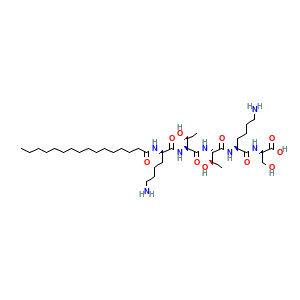 |
| CAS Number | 214047-00-4 |
| Alias / Common Name | Palmitoyl Pentapeptide-4; Palmitoyl Pentapeptide-3; Matrixyl; Pal-KTTKS |
| Molecular Formula | C39H75N7O10 |
| Molecular Weight | 802.1 g/mol |
| INCI Name | Palmitoyl Pentapeptide-4 |
| Peptide Sequence | Pal-Lys-Thr-Thr-Lys-Ser (KTTKS) — procollagen-derived matrix-signalling peptide |
| Purity / Assay | ≥98% (HPLC); confirm by batch COA |
| Appearance | White to off-white powder |
| Solubility / Handling | Limited direct water solubility due to palmitoyl chain; pre-dissolve in propylene glycol, butylene glycol or ethanol (2–5× dilution) before incorporation into aqueous phase |
| pH Stability | Stable across pH 4.5–7.0; evaluate in the target emulsion or serum base; confirm pH after addition |
| Storage | Store sealed in cool, dry conditions protected from direct light; follow batch COA and SDS |
> Mechanism & Positioning
Matrixyl (Palmitoyl Pentapeptide-4/3) delivers the KTTKS pentapeptide sequence — derived from the C-terminal domain of the type I procollagen α1 chain — to dermal fibroblasts via the palmitoyl fatty acid vector. Published Matrixyl literature discusses that the KTTKS motif interacts with fibronectin-receptor pathways (including β1-integrin signalling) in dermal fibroblasts, triggering downstream TGF-β agonism associated with increased collagen type I, type III and fibronectin production in cell-based model systems. Cell-based studies document upregulation of extracellular matrix components including laminin and collagen type IV in fibroblast model assays, building a broad matrix-synthesis signalling profile. Fibroblast model data also notes procollagen I C-peptide as a relevant output biomarker in Matrixyl-treated cultures.
Based on available in vitro fibroblast data, Matrixyl is positioned for matrix-care serum, advanced age-care emulsion and multi-lipopeptide blend applications. The fibronectin-receptor mechanism differentiates Matrixyl from copper-delivery actives such as GHK-Cu (LOX pathway), neuromuscular actives such as Argireline (SNARE complex), and TGF-β1 activators operating via TSP-1 mimicry such as Palmitoyl Tripeptide-5. Matrixyl is frequently evaluated alongside GHK-Cu (Copper Tripeptide-1) for complementary LOX-support and fibronectin-receptor positioning in premium serum architecture.
> Application Concepts
Emulsion and Cream Architecture
Matrixyl (Palmitoyl Pentapeptide-4/3) is the standard lipopeptide entry point for matrix-care cream and emulsion systems at 10–100 ppm (0.001–0.01%). Pre-dissolve the powder in propylene glycol, butylene glycol or ethanol (typically 1:2 to 1:5 weight ratio, 40–50°C with gentle stirring) before addition to the aqueous phase or emulsion during cool-down. In W/O and W/Si emulsions, the palmitoyl chain may also allow partial incorporation via the lipid phase — evaluate phase distribution and assay retention in the target base. Confirm dissolution homogeneity, pH (4.5–7.0) and colour stability in representative batch scale before committing to manufacturing.
Serum and Multi-Lipopeptide Concentrate Architecture
In aqueous serum concentrates, pre-dissolve Matrixyl in a minimal volume of butylene glycol or 1,3-propanediol at 40–50°C, then add to the water phase at cool-down. The KTTKS sequence is stable across pH 4.5–7.0 and compatible with typical serum humectants (hyaluronic acid, glycerin), film formers and preservative systems. Multi-lipopeptide matrices combining Matrixyl with Palmitoyl Tripeptide-1 (fibronectin–collagen I axis), Palmitoyl Tetrapeptide-7 (calming interleukin modulation) and Palmitoyl Tripeptide-5 (alternative TGF-β pathway) require confirmation of combined solubility and stability in the glycol pre-mix system before incorporation.
Multi-Mechanism Age-Care Peptide Blends
For broad multi-mechanism age-care positioning, Matrixyl (Palmitoyl Pentapeptide-4/3) is evaluated alongside actives that address distinct signalling pathways: GHK-Cu (Copper Tripeptide-1) provides copper-mediated LOX support for collagen and elastin crosslinking; Acetyl Hexapeptide-8 (Argireline) targets the SNARE complex for neuromuscular relaxation; and Palmitoyl Tetrapeptide-7 addresses inflammatory cytokine modulation relevant to age-related dermal degradation. Each active operates via an independent mechanism, making functional pathway combination feasible within a single concentrate — subject to stability and compatibility confirmation in the complete formulation system.
> Handling & Formulation Notes
Matrixyl (Palmitoyl Pentapeptide-4/3) does not dissolve directly in cold water at typical cosmetic use concentrations; the palmitoyl chain requires a glycol or alcohol carrier for dispersion before introduction to the aqueous phase. Standard approach: weigh the required amount of Matrixyl powder, add 2–5 parts propylene glycol or butylene glycol, warm to 40–50°C and stir until clear. Introduce the resulting concentrate into the water phase or emulsion during the cool-down stage below 40°C; avoid prolonged exposure above 50°C to prevent peptide degradation.
Verify pH in the finished formulation is within 4.5–7.0 after all actives and buffering agents are incorporated. At high levels of anionic polymers (carbomers, xanthan), evaluate interaction with the glycol pre-mix in the target base at the manufacturing scale. Confirm colour, clarity, assay retention and preservative efficacy via accelerated stability testing across the intended shelf-life period before scale-up.
> Supply & Documentation
Matrixyl (Palmitoyl Pentapeptide-4/3) (CAS 214047-00-4) is available from TCS NEXUS S.L. (Valencia, Spain) for B2B cosmetic raw material projects. Standard documentation: COA, TDS, SDS. Sample and bulk quantities are discussed on a per-project basis; contact info@tcspeptides.com to initiate a sourcing review.
TCS NEXUS S.L. supports procurement and formulation teams in Germany, France, Italy, Spain, the United Kingdom, the Netherlands, Belgium, Poland, Sweden and Portugal, as well as international buyers in the United States, Canada, Japan, South Korea, Australia and New Zealand.
> Packaging & Storage
Matrixyl (Palmitoyl Pentapeptide-4/3) is supplied in sealed aluminium foil bags or bulk containers. Minimum quantities and packaging configurations are confirmed per order. Store below 25°C in a cool, dry location protected from light and moisture. Follow batch COA and SDS for specific storage and handling conditions.
> FAQ
What is Matrixyl (Palmitoyl Pentapeptide-4/3)?
Matrixyl (Palmitoyl Pentapeptide-4/3) (CAS 214047-00-4) is a palmitoylated pentapeptide raw material consisting of the KTTKS sequence (Lys-Thr-Thr-Lys-Ser) — derived from the C-terminal domain of type I procollagen α1 chain — conjugated to a palmitic acid chain for skin penetration. TCS NEXUS S.L. (Valencia, Spain) supplies Matrixyl as a B2B cosmetic ingredient for matrix-care, advanced age-care and multi-lipopeptide blend applications.
What is the CAS number for Matrixyl and what does “Palmitoyl Pentapeptide-4/3” mean?
The CAS number for Matrixyl is 214047-00-4. “Palmitoyl Pentapeptide-4” is the current INCI name; “Palmitoyl Pentapeptide-3” was the previous INCI designation — both refer to the same Pal-KTTKS molecule (CAS 214047-00-4). The “4/3” notation on some supplier documents reflects this INCI name transition. For regulatory documentation, confirm the INCI version required by your market authority and use it consistently.
How does Pal-KTTKS signal collagen synthesis — what is the matrikine mechanism?
Matrixyl (Palmitoyl Pentapeptide-4, Pal-KTTKS) is the palmitoylated form of the KTTKS pentapeptide, a subfragment of the C-terminal propeptide of type I procollagen. Acting as a matrikine — a matrix-derived signalling fragment — KTTKS feeds back to dermal fibroblasts to upregulate synthesis of type I and III collagen, fibronectin and glycosaminoglycans, supporting extracellular-matrix renewal positioning. The palmitoyl (C16) chain adds lipophilicity to aid stratum-corneum penetration of the otherwise hydrophilic peptide.
What differentiates Matrixyl from GHK-Cu and Argireline in multi-peptide systems?
Matrixyl operates via fibronectin-receptor (β1-integrin) signalling and TGF-β agonism in fibroblasts — targeting matrix synthesis via procollagen fragment signalling. GHK-Cu (Copper Tripeptide-1) operates via copper delivery to support lysyl oxidase (LOX), which crosslinks collagen and elastin fibres — a separate, copper-dependent mechanism. Argireline (Acetyl Hexapeptide-8) targets the SNARE complex at the neuromuscular junction — a completely independent expression-line relaxation mechanism. These three mechanisms are non-competing, making Matrixyl + GHK-Cu + Argireline a mechanistically coherent multi-pathway combination for advanced age-care serum positioning.
What use level of Pal-KTTKS is typical, and does the pure-peptide vs trade-solution basis matter?
Use level is formulation- and project-specific and varies by claim direction, so evaluate conservatively rather than to a fixed figure. As a supplier we provide the pure Palmitoyl Pentapeptide-4 raw material with COA, so confirm your target on a pure-peptide basis for your own study design — and note that many market references quote the diluted trade-solution basis, not pure peptide. Contact info@tcspeptides.com to align documentation with your dosing basis.
How does Pal-KTTKS complement the Matrixyl 3000 peptides (Pal-GHK and Pal-GQPR)?
Pal-KTTKS (the original Matrixyl) works through the procollagen matrikine pathway and is complementary to Palmitoyl Tripeptide-1 (Pal-GHK) and Palmitoyl Tetrapeptide-7 (Pal-GQPR) — the two matrikines combined in Matrixyl 3000 — enabling multi-matrikine serum architectures. It can also be layered with GHK-Cu (Copper Tripeptide-1) for LOX-mediated collagen crosslinking and with niacinamide for broader tone and barrier positioning. Confirm combined stability and pH alignment in the finished base.
How should Matrixyl be pre-dissolved for formulation?
Pre-dissolve Matrixyl powder in propylene glycol, butylene glycol or ethanol at a 1:2 to 1:5 weight ratio by warming to 40–50°C with gentle stirring until the solution is clear. This glycol concentrate is then added to the water phase or emulsion during the cool-down stage below 40°C. Direct addition of the dry powder to cold water is not recommended as it will not dissolve homogeneously. Confirm clarity and homogeneity of the pre-mix before incorporating into the batch.
What pH and finished-formula stability considerations apply to Palmitoyl Pentapeptide-4?
Palmitoyl Pentapeptide-4 (Pal-KTTKS) is stable across pH 4.5–7.0, covering typical serum and emulsion targets. Add during the cool-down phase below 45°C and confirm the finished-product pH after all actives and buffering agents are incorporated. When formulating alongside low-pH actives such as ascorbic acid, evaluate combined stability and consider separate regimen steps or pH zones.
How does the original Matrixyl (Pal-KTTKS) differ from Matrixyl 3000 and Matrixyl synthe’6?
This raw material is the original Matrixyl — Palmitoyl Pentapeptide-4 (Pal-KTTKS, formerly INCI Palmitoyl Pentapeptide-3, CAS 214047-00-4). It is not Matrixyl 3000 (a two-peptide Pal-GHK/Pal-GQPR system) or Matrixyl synthe’6 (based on Palmitoyl Tripeptide-38); those carry different INCIs and CAS numbers. When ordering or preparing CPNP documentation, specify INCI Palmitoyl Pentapeptide-4 and CAS 214047-00-4, and verify identity against the batch COA.
How should Matrixyl (Palmitoyl Pentapeptide-4/3) be stored?
Store Matrixyl (Palmitoyl Pentapeptide-4/3) sealed below 25°C in a cool, dry location protected from light and moisture. The glycol pre-mix concentrate should be prepared fresh or stored under appropriate conditions confirmed by stability data. Follow specific storage and handling conditions stated in the SDS and batch COA.
What documentation does TCS NEXUS S.L. provide for Matrixyl?
TCS NEXUS S.L. provides standard B2B documentation for Matrixyl (Palmitoyl Pentapeptide-4/3) including COA (confirming CAS 214047-00-4, HPLC purity ≥98%), TDS (Technical Data Sheet) and SDS (Safety Data Sheet). Additional documentation such as specification sheets, INCI confirmation letters and batch traceability records are available on a per-project basis. Contact info@tcspeptides.com to initiate a documentation and sourcing discussion.
What MOQ and sample options are available for Matrixyl?
Sample and bulk quantities for Matrixyl (Palmitoyl Pentapeptide-4/3) are confirmed on a per-project basis through TCS NEXUS S.L. Minimum order quantities depend on current stock, packaging configuration and project scope. Formulators and brand R&D teams are encouraged to request samples for stability, solubility and compatibility evaluation before bulk planning. Contact info@tcspeptides.com with project scope and specification to begin a sourcing review.
Is Palmitoyl Pentapeptide-4 (INCI) compliant with EU Cosmetics Regulation 1223/2009?
Palmitoyl Pentapeptide-4 (INCI) is not listed as a restricted, prohibited or regulated substance under EU Cosmetics Regulation 1223/2009 Annexes II–VI. The finished product manufacturer is responsible for confirming compliance, including the CPSR and CPNP notification. Use CAS 214047-00-4 and INCI name Palmitoyl Pentapeptide-4 consistently in regulatory documentation; confirm purity and identity with the batch COA.
> Technical Support and Samples
Request COA documents, sample availability, or support for custom synthesis.