
Copper Tripeptide-1 (2:1, HOAc) (CAS 130120-57-9) is supplied by TCS NEXUS S.L. (Valencia, Spain) for European cosmetic formulators, brand R&D teams and B2B buyers reviewing copper carrier peptide, stoichiometry comparison and matrix-care raw material applications. The 2:1 molar ratio describes two Gly-His-Lys tripeptide chains coordinating a single Cu²⁺ ion, yielding a bis-tripeptide copper complex with molecular weight 862.4 g/mol and a distinct chelation profile from the standard 1:1 commercial grade (CAS 89030-95-5).
> Technical Specifications
| Product Name | Copper Tripeptide-1 (2:1, HOAc) |
|---|---|
| Molecular Structure | 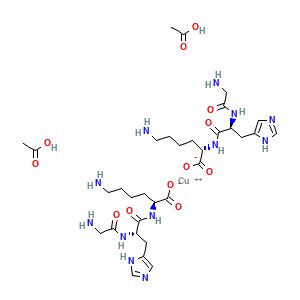 |
| CAS Number | 130120-57-9 |
| Alias / Common Name | Bis(Tripeptide-1) Copper Acetate; Prezatide copper acetate (2:1); PC-1020 acetate; GHK₂Cu |
| Molecular Formula | C32H54CuN12O12 |
| Molecular Weight | 862.4 g/mol |
| INCI Name | Copper Tripeptide-1 |
| Peptide Sequence | 2 × (Gly-His-Lys) — bis-tripeptide complex (2:1 GHK:Cu²⁺ chelation) |
| Purity / Assay | ≥98% (HPLC); confirm by batch COA |
| Appearance | White to off-white powder; forms blue-green solution when dissolved in water |
| Solubility / Handling | Water soluble; dissolve in water or aqueous phase prior to incorporation; compare colour, clarity and pH behaviour against 1:1 grade in the target base |
| pH Stability | Review in mildly acidic to neutral aqueous systems (pH 5.0–7.0); monitor pH and colour after addition; confirm in target base |
| Storage | Store sealed in cool, dry conditions protected from direct light and moisture; follow batch COA and SDS |
> Mechanism & Positioning
Copper Tripeptide-1 (2:1, HOAc) coordinates Cu²⁺ via a bis-tripeptide sandwich complex: two Gly-His-Lys chains ligate a single Cu²⁺ ion through the histidine imidazole nitrogens and α-amino termini, forming a thermodynamically stable 2:1 chelate with MW 862.4 g/mol. Published copper peptide literature discusses that GHK-Cu complexes facilitate dermal copper delivery, supporting copper-dependent enzyme activity — particularly lysyl oxidase (LOX), which catalyses crosslinking of collagen and elastin fibres. Cell-based studies document modulation of MMP-1 and MMP-2 activity alongside TIMP-1 upregulation in dermal fibroblast models, consistent with a matrix-remodelling signalling profile. Fibroblast model data also notes TGF-β1 pathway engagement and discussion of collagen type I and III synthesis upregulation within the wider GHK-Cu literature.
The 2:1 stoichiometry means that per gram of raw material, the copper content is lower than the 1:1 grade — a relevant parameter when building development protocols where copper dose is controlled against a specific target. Copper Tripeptide-1 (2:1, HOAc) is positioned for formulators who need the 2:1 bis-tripeptide complex for stoichiometry comparison, academic reference alignment or specific formulation architecture, alongside the standard GHK-Cu HOAc (1:1, CAS 89030-95-5) and GHK-Cu HCl (1:1, CAS 89030-95-5) commercial grades.
> Application Concepts
Stoichiometry Comparison in Development Protocols
When building a copper tripeptide evaluation protocol, formulators may run 1:1 and 2:1 molar ratio grades side by side to assess whether the chelation stoichiometry affects colour development, dissolution behaviour or complex stability in the target base. Copper Tripeptide-1 (2:1, HOAc) has MW 862.4 g/mol compared to approximately 402–467 g/mol for the 1:1 grades; use-level calculations based on peptide mass versus copper-delivery target will therefore differ between stoichiometries. The characteristic blue-green colour serves as a practical quality indicator — verify onset, intensity and stability against the 1:1 grade under identical formulation conditions, pH and temperature. Stability results from both forms should be compared before committing to a single grade for scale-up.
Regenerative Serum and Multi-Peptide Systems
Copper Tripeptide-1 (2:1, HOAc) integrates into standard pH 5.5–6.5 aqueous serum bases with water dissolution; no co-solvent or emulsifier pre-dispersion is required. The HOAc (acetate) counterion offers clean aqueous dissolution compatible with alcohol-free concentrate architecture. For multi-pathway matrix-care positioning, the 2:1 grade may be evaluated alongside Matrixyl (Palmitoyl Pentapeptide-4/3) to address both copper-mediated LOX support and fibronectin-receptor signalling, or with Palmitoyl Tripeptide-5 for complementary TGF-β1 pathway modulation. Introduce during cool-down below 40°C; avoid prolonged heating above 45°C to preserve Cu²⁺ chelate integrity.
Portfolio Positioning for Copper Peptide Lines
Technical buyers comparing copper peptide forms by CAS number, stoichiometry and documentation package will find Copper Tripeptide-1 (2:1, HOAc) (CAS 130120-57-9) distinct from the 1:1 grades (CAS 89030-95-5) in identity documentation. Procurement teams building multi-SKU copper peptide portfolios may source both 1:1 and 2:1 forms to support different R&D project tracks or customer formulation requirements. TCS NEXUS S.L. supplies both stoichiometries with standard COA, TDS and SDS documentation from Valencia, Spain.
> Handling & Formulation Notes
Dissolve Copper Tripeptide-1 (2:1, HOAc) in water or the aqueous phase prior to incorporation; the complex is water soluble and does not require co-solvent or surfactant pre-dispersion. Introduce during the cool-down phase at temperatures below 40°C — prolonged exposure above 45°C risks Cu²⁺ dissociation from the 2:1 bis-tripeptide chelate. Monitor formulation pH within 5.0–7.0; the characteristic blue-green colour of the dissolved complex provides a practical visual quality check after addition — colour shift toward pale or colourless may indicate Cu²⁺ dissociation from pH drift or chelating-agent competition.
Evaluate compatibility with EDTA and other chelating agents at target cosmetic use concentrations, as competitive copper sequestration can disrupt the 2:1 complex. Compare colour development and stability against the 1:1 grade in parallel in the same base to characterise any stoichiometry-dependent behaviour. Confirm pH, colour, clarity, assay retention and preservative compatibility via accelerated stability testing before scale-up.
> Supply & Documentation
Copper Tripeptide-1 (2:1, HOAc) (CAS 130120-57-9) is available from TCS NEXUS S.L. (Valencia, Spain) for B2B cosmetic raw material projects. Standard documentation: COA, TDS, SDS. Sample and bulk quantities are discussed on a per-project basis; contact info@tcspeptides.com to initiate a sourcing review.
TCS NEXUS S.L. supports procurement and formulation teams in Germany, France, Italy, Spain, the United Kingdom, the Netherlands, Belgium, Poland, Sweden and Portugal, as well as international buyers in the United States, Canada, Japan, South Korea, Australia and New Zealand.
> Packaging & Storage
Copper Tripeptide-1 (2:1, HOAc) is supplied in sealed aluminium foil bags or bulk containers. Minimum quantities and packaging configurations are confirmed per order. Store below 25°C in a cool, dry location protected from light and moisture. Follow batch COA and SDS for specific storage and handling conditions.
> FAQ
What is Copper Tripeptide-1 (2:1, HOAc)?
Copper Tripeptide-1 (2:1, HOAc) (CAS 130120-57-9) is a bis-tripeptide copper acetate raw material in which two Gly-His-Lys chains coordinate a single Cu²⁺ ion in a 2:1 molar complex, with acetate as the counterion. TCS NEXUS S.L. (Valencia, Spain) supplies this bis-tripeptide copper complex as a B2B cosmetic ingredient for stoichiometry comparison, regenerative serum and matrix-care formulation concepts.
What is the CAS number for Copper Tripeptide-1 (2:1, HOAc) and how does it differ from the 1:1 grade?
The CAS number for Copper Tripeptide-1 (2:1, HOAc) is 130120-57-9. The 1:1 commercial grades (both HCl and HOAc salt forms) carry CAS 89030-95-5. The 2:1 grade has MW 862.4 g/mol — approximately double that of the 1:1 grade (~402–467 g/mol) — as two Gly-His-Lys chains ligate each Cu²⁺ ion. This stoichiometric difference affects copper delivery per gram of raw material and should be accounted for in use-level calculations and regulatory identity documentation.
How does the 2:1 GHK:copper complex work, and how is it built?
Copper Tripeptide-1 (2:1) is a bis-tripeptide copper complex in which two Gly-His-Lys chains coordinate one Cu²⁺ ion (GHK₂Cu), versus the 1:1 GHK-Cu grade. It delivers the same copper-cofactor activity — supporting lysyl oxidase crosslinking and matrix synthesis — but the higher peptide-to-copper ratio changes the mass balance of active carried per unit copper, which is the basis for choosing it in specific formulation designs.
Why would a formulator choose Copper Tripeptide-1 (2:1, HOAc) over the standard 1:1 grade?
Formulators choose the 2:1 grade for three main reasons: stoichiometry comparison (parallel evaluation of 1:1 versus 2:1 copper chelation to characterise any formulation-performance or stability differences); academic and regulatory reference alignment (some published literature and patent citations use the 2:1 complex specifically, making CAS 130120-57-9 the appropriate identity for those references); and portfolio differentiation (brands and contract manufacturers sourcing multiple copper peptide forms to support different R&D tracks or customer specifications). For initial serum development or scale-up projects, the standard 1:1 commercial grade (CAS 89030-95-5) remains the conventional entry point.
What use level of the 2:1 grade is typical, and how does the stoichiometry affect it?
Establish the use level conservatively for your base and claim rather than to a fixed figure, and remember the 2:1 grade carries twice the GHK per copper of the 1:1 form — so your active-peptide and active-copper calculations differ from the standard grade. Dose on the pure-material COA basis; contact info@tcspeptides.com to align documentation.
What actives combine well with Copper Tripeptide-1 (2:1, HOAc) in multi-peptide systems?
Copper Tripeptide-1 (2:1, HOAc) builds complementary multi-mechanism systems with three distinct actives: Matrixyl (Palmitoyl Pentapeptide-4/3) addresses fibronectin-receptor signalling and TGF-β agonism — a different signalling level from the copper-mediated LOX pathway; Acetyl Hexapeptide-8 (Argireline) targets the SNARE complex, a completely separate mechanism that coexists cleanly at pH 5.0–7.0; and Palmitoyl Tripeptide-5 modulates TGF-β1 via fibronectin interaction. Avoid combining with high-dose EDTA or ascorbic acid at pH below 4.5, as both can disrupt Cu²⁺ complex integrity. Confirm colour stability and assay retention in combined systems before scale-up.
How does the 2:1 stoichiometry affect formulation calculations?
The 2:1 molar complex has MW 862.4 g/mol versus approximately 402–467 g/mol for the 1:1 grades — meaning 1 g of 2:1 grade contains roughly half the copper content of 1 g of 1:1 grade at equal weight percent. Formulators targeting a specific copper delivery level should adjust use-level calculations accordingly. For regulatory documentation, the distinct CAS 130120-57-9 and MW must be used — they cannot be interchanged with 1:1 grade identity data. Verify stoichiometry on each batch COA when comparing across suppliers.
What pH keeps the 2:1 copper complex intact?
Hold Copper Tripeptide-1 (2:1) around pH 5.0–7.0; as with the 1:1 grade, low pH below about 4.5 risks Cu²⁺ dissociation and loss of the intended copper delivery. Confirm the finished-product pH after all actives are incorporated and keep it out of high-dose ascorbic-acid systems.
What addition temperature is recommended during manufacturing?
Introduce Copper Tripeptide-1 (2:1, HOAc) during the cool-down phase at temperatures below 40°C. Prolonged exposure above 45°C risks Cu²⁺ dissociation from the bis-tripeptide chelate. For aqueous serums and tonics, dissolve in the water phase at ambient temperature and add to the batch after cooling. Confirm thermal stability in representative scale batches with accelerated stability data before committing to the manufacturing process.
How should Copper Tripeptide-1 (2:1, HOAc) be stored?
Store Copper Tripeptide-1 (2:1, HOAc) sealed below 25°C in a cool, dry location protected from light and moisture. Once opened, reseal containers immediately and use within a defined period confirmed by the batch COA. Follow specific storage and handling conditions stated in the SDS.
What documentation does TCS NEXUS S.L. provide for Copper Tripeptide-1 (2:1, HOAc)?
TCS NEXUS S.L. provides standard B2B documentation for Copper Tripeptide-1 (2:1, HOAc) including COA (confirming identity CAS 130120-57-9, HPLC purity ≥98%), TDS (Technical Data Sheet) and SDS (Safety Data Sheet). Additional documentation such as specification sheets and batch traceability records are available on a per-project basis. Contact info@tcspeptides.com to initiate a documentation and sourcing discussion.
What MOQ and sample options are available for Copper Tripeptide-1 (2:1, HOAc)?
Sample and bulk quantities are confirmed on a per-project basis through TCS NEXUS S.L. Minimum order quantities depend on current stock, packaging configuration and project scope. R&D teams are encouraged to request samples for stoichiometry comparison and stability evaluation before bulk planning. Contact info@tcspeptides.com with project scope and required specification to begin a sourcing review.
Is Copper Tripeptide-1 (INCI) compliant with EU Cosmetics Regulation 1223/2009?
Copper Tripeptide-1 is not listed as a restricted, prohibited or regulated substance under EU Cosmetics Regulation 1223/2009 Annexes II–VI. The finished product manufacturer is responsible for confirming compliance under EU Regulation 1223/2009, including the CPSR and CPNP notification. For the 2:1 grade, use CAS 130120-57-9 and INCI name Copper Tripeptide-1 consistently across regulatory documentation; confirm stoichiometry and purity with the batch COA.
> Technical Support and Samples
Request COA documents, sample availability, or support for custom synthesis.