
GHK-Cu (Copper Tripeptide-1 HCl) (CAS 89030-95-5) is supplied by TCS NEXUS S.L. (Valencia, Spain) for European cosmetic formulators, brand R&D teams and B2B buyers reviewing copper carrier peptide, regenerative serum and matrix-care raw material applications. The HCl (hydrochloride) salt form is the standard commercial grade for copper tripeptide supply, offering broad availability for aqueous serum, tonic and scalp-active formulation development at pH 5.0–7.0.
> Technical Specifications
| Product Name | GHK-Cu (Copper Tripeptide-1 HCl) |
|---|---|
| Molecular Structure | 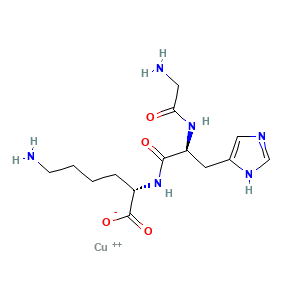 |
| CAS Number | 89030-95-5 |
| Alias / Common Name | GHK-Cu; Copper Tripeptide-1; Prezatide; CP-1; GHK·Cu |
| Molecular Formula | C14H23CuN6O4+ |
| Molecular Weight | 402.92 g/mol |
| INCI Name | Copper Tripeptide-1 |
| Peptide Sequence | Gly-His-Lys — carrier peptide (Cu²⁺ chelation, 1:1 complex) |
| Purity / Assay | ≥98% (HPLC); confirm by batch COA |
| Appearance | White to off-white powder; forms characteristic blue-green solution when dissolved |
| Solubility / Handling | Freely water-soluble; dissolve in water or aqueous phase prior to incorporation; hygroscopic — store desiccated and weigh quickly under ambient conditions |
| pH Stability | Optimal stability at pH 5.0–7.0; Cu²⁺ dissociation risk below pH 4.5; confirm in target base |
| Storage | Store sealed in desiccated, cool and dry conditions, protected from light and moisture |
> Mechanism & Positioning
GHK-Cu (Copper Tripeptide-1 HCl) coordinates copper(II) ions in a 1:1 molar peptide–metal complex via the histidine imidazole nitrogen and the α-amino terminus of the Gly-His-Lys backbone, forming a stable chelate. Published copper peptide literature discusses that this complex facilitates dermal copper delivery, supporting copper-dependent enzyme activity — particularly lysyl oxidase (LOX), which catalyses crosslinking of collagen and elastin fibres. Cell-based studies document modulation of MMP-1 and MMP-2 activity alongside TIMP-1 upregulation, producing a matrix-remodelling signalling profile. Fibroblast model data also notes TGF-β1 pathway involvement, with associated discussion of collagen type I and type III synthesis upregulation.
Based on the available in vitro evidence, formulators position GHK-Cu within regenerative serum, advanced age-care and scalp-active cosmetic applications. The HCl salt form coordinates the same active copper–Gly-His-Lys chelate as the acetate form; the chloride counterion at typical use levels (0.5–2.0%) contributes minimally to formulation ionic strength. GHK-Cu (HCl) may be evaluated alongside GHK-Cu (Copper Tripeptide-1 HOAc) for salt-form comparison, or with Matrixyl (Palmitoyl Pentapeptide-4/3) for complementary LOX-mediated and fibronectin-receptor matrix-care positioning.
> Application Concepts
Regenerative and Age-Care Serum Architecture
GHK-Cu (Copper Tripeptide-1 HCl) integrates readily into standard pH 5.5–6.5 aqueous serum bases at evaluation concentrations of 0.5–2.0%. The blue-green colour of the dissolved copper–peptide chelate serves as a practical quality indicator during manufacture — a shift to pale or colourless signals pH drift or chelating-agent competition disrupting Cu²⁺ retention. The HCl form is freely water-soluble in glycerin–water and hyaluronic acid bases without co-solvents or emulsifier pre-dispersion, making it the standard entry point for copper tripeptide evaluation in regenerative and age-care serum architecture. For multi-pathway matrix-care positioning, GHK-Cu (HCl) may be combined with Matrixyl (Palmitoyl Pentapeptide-4/3) to address both copper-mediated LOX support and fibronectin-receptor signalling in a single concentrate.
Scalp and Hair Follicle Active Systems
At 0.5–1.5% in pH 5.0–6.5 tonic or leave-on scalp formulations, GHK-Cu (Copper Tripeptide-1 HCl) is a standard starting point for formulators exploring copper-delivery concepts relevant to dermal papilla cell biology. The carrier peptide mechanism differentiates GHK-Cu from energy-pathway actives such as caffeine or nutritional cofactors such as biotin by targeting a copper-dependent pathway relevant to dermal papilla cell biology. Scalp leave-on and rinse-off products built on water–alcohol–polyol bases accommodate the water-soluble HCl form without auxiliary solvents. Compatibility with cationic conditioning polymers (e.g., polyquaternium compounds) should be confirmed in the target base, and pH verified to remain above 4.5 throughout shelf life to preserve Cu²⁺ chelate integrity. The HCl grade is widely stocked, making it convenient for brands developing scalp actives at scale.
Salt-Form Selection in Development Protocols
When building a development protocol for copper tripeptide actives, formulators commonly evaluate the HCl and HOAc salt forms side by side. GHK-Cu (Copper Tripeptide-1 HCl) is the standard commercial grade — broad availability, established supply chain and straightforward aqueous dissolution profile at pH 5.0–7.0. In standard pH 5.5–6.5 aqueous concentrates without high levels of chelating agents, the HCl and HOAc forms typically yield equivalent copper–peptide complex stability. Where minimal ionic-strength contribution or alcohol-free concentrate architecture is a primary formulation objective, formulators may compare against the HOAc form to determine which dissolution profile best fits the target base. The HCl form is the practical first choice for initial development batches and scale-up projects where commercial availability is a priority.
> Handling & Formulation Notes
Dissolve GHK-Cu (Copper Tripeptide-1 HCl) in the water or aqueous phase at concentrations up to 2.0%; the peptide is freely water-soluble and does not require co-solvent or surfactant pre-dispersion. Note that the HCl salt form is hygroscopic — store desiccated, weigh rapidly and reseal containers immediately after use to prevent moisture uptake affecting powder flowability and assay accuracy. Introduce during the cool-down phase below 40°C; prolonged exposure above 45°C risks Cu²⁺ dissociation from the Gly-His-Lys chelate. Maintain formulation pH within 5.0–7.0; below pH 4.5 copper dissociation increases and the characteristic blue-green colour may fade — verify final pH after all acidic actives and buffering agents are incorporated.
Evaluate compatibility with EDTA and other chelating agents, as competitive copper sequestration can disrupt the complex at typical cosmetic chelant concentrations. Ascorbic acid systems at low pH introduce reducing conditions that may affect Cu²⁺ retention; a two-product regimen or pH buffering strategy should be assessed. Confirm colour, clarity, assay retention and pH stability via accelerated stability testing across the intended shelf-life period before scale-up.
> Supply & Documentation
GHK-Cu (Copper Tripeptide-1 HCl) (CAS 89030-95-5) is available from TCS NEXUS S.L. (Valencia, Spain) for B2B cosmetic raw material projects. Standard documentation: COA, TDS, SDS. Sample and bulk quantities are discussed on a per-project basis; contact info@tcspeptides.com to initiate a sourcing review.
TCS NEXUS S.L. supports procurement and formulation teams in Germany, France, Italy, Spain, the United Kingdom, the Netherlands, Belgium, Poland, Sweden and Portugal, as well as international buyers in the United States, Canada, Japan, South Korea, Australia and New Zealand.
> Packaging & Storage
GHK-Cu (Copper Tripeptide-1 HCl) is supplied in sealed aluminium foil bags or bulk containers. Minimum quantities and packaging configurations are confirmed per order. Store below 25°C in a cool, dry, desiccated location — the HCl salt form is hygroscopic and requires careful moisture protection throughout storage and handling. Follow batch COA and SDS for specific storage and handling conditions.
> FAQ
What is GHK-Cu (Copper Tripeptide-1 HCl)?
GHK-Cu (Copper Tripeptide-1 HCl) is a copper carrier peptide raw material with CAS 89030-95-5, consisting of the tripeptide Gly-His-Lys coordinated to a Cu²⁺ ion in a 1:1 molar complex with chloride as the counterion. TCS NEXUS S.L. (Valencia, Spain) supplies GHK-Cu HCl as a B2B cosmetic ingredient for regenerative serum, scalp-active and advanced age-care formulation concepts.
What is the CAS number for GHK-Cu (Copper Tripeptide-1 HCl) and how does it differ from the HOAc form?
The CAS number for GHK-Cu (Copper Tripeptide-1 HCl) is 89030-95-5; this CAS applies to the Copper Tripeptide-1 complex regardless of counterion. The HCl form carries chloride as the counterion while the HOAc form carries acetate — the active copper–Gly-His-Lys chelate is the same, but solubility profile, hygroscopicity and ionic-strength contribution may differ. The HCl form is the standard commercial grade; the HOAc form may offer slightly cleaner dissolution in low-ionic-strength, alcohol-free concentrates. Confirm the salt form on the batch COA when building regulatory documentation.
How does GHK-Cu deliver copper and drive matrix remodelling — what is the LOX mechanism?
GHK-Cu is the 1:1 copper(II) complex of the tripeptide Gly-His-Lys. The GHK carrier chelates and delivers bioavailable Cu²⁺, a cofactor for lysyl oxidase (LOX) — the enzyme that crosslinks collagen and elastin — and for superoxide dismutase. Published copper-peptide literature discusses upregulation of collagen I, elastin, decorin and glycosaminoglycan synthesis together with modulation of the matrix metalloproteinase/TIMP balance, positioning Copper Tripeptide-1 for firmness, remodelling and post-procedure skin-conditioning claim directions.
What molecular targets distinguish GHK-Cu from signal peptides such as Matrixyl?
GHK-Cu operates via a copper-delivery mechanism focused on LOX pathway support — copper is the essential cofactor for lysyl oxidase, which crosslinks collagen and elastin fibres. Signal peptides such as Matrixyl (Palmitoyl Pentapeptide-4) act through fibronectin-receptor interaction and TGF-β agonism in fibroblasts, targeting matrix synthesis at a different signalling level. This mechanistic difference makes GHK-Cu and Matrixyl complementary in multi-active serum formulations designed for broad matrix-care positioning.
What use level of GHK-Cu is typical, and how does the copper affect the aesthetic ceiling?
The right use level depends on your base, claim direction and study design, so treat it as a range to be established conservatively rather than a single number. Note that GHK-Cu develops a characteristic blue-green tint that becomes visible at higher levels and can set a practical aesthetic ceiling in clear or light-coloured bases. Dose on a pure Copper Tripeptide-1 (HCl) basis using the batch COA; contact info@tcspeptides.com to align documentation with your target.
Which actives are incompatible with GHK-Cu — how do chelators and reducing agents affect the copper?
The copper is the critical formulation constraint. Strong chelators such as EDTA can strip Cu²⁺ from the complex, and reducing agents — ascorbic acid (vitamin C), thiols such as glutathione, and sulfites — can reduce or destabilise the copper, so keep GHK-Cu in separate regimen steps or phases from these. It pairs well with matrix-signal peptides such as Matrixyl (Palmitoyl Pentapeptide-4) and with niacinamide. Confirm compatibility and colour stability in the finished base.
When should formulators choose GHK-Cu HCl over the HOAc form?
GHK-Cu (Copper Tripeptide-1 HCl) is the standard commercial entry point for copper tripeptide evaluation — broad supply availability, established documentation packages and straightforward dissolution in standard aqueous serum bases at pH 5.5–6.5. It is the practical first choice for initial development batches, scale-up projects and applications where commercial availability and pricing consistency are priorities. The HOAc form may be preferred where low ionic strength or alcohol-free concentrate architecture is a primary formulation objective, or where acetate counterion compatibility with the specific preservative system offers a technical advantage. Evaluate both forms in the target base to determine optimal salt form selection for the project.
What pH keeps the Cu²⁺ complex intact, and why avoid low-pH systems?
Formulate Copper Tripeptide-1 at pH 5.0–7.0. Below about pH 4.5 the Cu²⁺ can dissociate from the tripeptide, degrading both stability and the intended copper delivery — so it is a poor fit for low-pH systems such as high-dose ascorbic acid serums (pH 2.5–3.5). Confirm the finished-product pH after all actives and buffering agents are incorporated.
How should hygroscopic GHK-Cu HCl be handled and added during manufacturing?
Copper Tripeptide-1 HCl is hygroscopic — keep it desiccated and weigh quickly under ambient conditions to limit moisture pickup. It is freely water-soluble; dissolve it in the water phase and add during the cool-down phase below 45°C. The solution develops the characteristic blue-green colour, which is expected — account for it when setting the finished-product shade.
How should GHK-Cu (Copper Tripeptide-1 HCl) be stored?
Store GHK-Cu (Copper Tripeptide-1 HCl) sealed in desiccated conditions below 25°C, protected from light and moisture. The HCl salt form is hygroscopic — humid storage environments can affect powder flowability and assay stability. Once a container is opened, reseal immediately and use within a defined period, confirming assay by the batch COA. Follow specific storage and handling conditions stated in the SDS.
What documentation does TCS NEXUS S.L. provide for GHK-Cu (Copper Tripeptide-1 HCl)?
TCS NEXUS S.L. provides standard B2B documentation for GHK-Cu (Copper Tripeptide-1 HCl) including COA (Certificate of Analysis confirming HPLC purity ≥98%), TDS (Technical Data Sheet) and SDS (Safety Data Sheet). Additional documentation such as specification sheets, INCI confirmation letters and batch traceability records are available on a per-project basis. Contact info@tcspeptides.com to initiate a documentation and sourcing discussion.
What MOQ and sample options are available for GHK-Cu (Copper Tripeptide-1 HCl)?
Sample and bulk quantities for GHK-Cu (Copper Tripeptide-1 HCl) are confirmed on a per-project basis through TCS NEXUS S.L. Minimum order quantities depend on current stock, packaging configuration and project scope. Formulators and brand R&D teams are encouraged to request samples for stability and compatibility evaluation before committing to bulk orders. Contact info@tcspeptides.com with project scope and required specification to begin a sourcing review.
Is Copper Tripeptide-1 (INCI) compliant with EU Cosmetics Regulation 1223/2009?
Copper Tripeptide-1 is not listed as a restricted, prohibited or regulated substance under EU Cosmetics Regulation 1223/2009 Annexes II–VI, and is used in cosmetic formulations as a cosmetic ingredient. The finished product manufacturer is responsible for confirming compliance under EU Regulation 1223/2009, including the Cosmetic Product Safety Report (CPSR) and CPNP notification. CAS 89030-95-5 and INCI name Copper Tripeptide-1 should be used consistently across regulatory documentation; confirm salt form and purity with the batch COA.
> Technical Support and Samples
Request COA documents, sample availability, or support for custom synthesis.