
Carnosine HCl (CAS 5852-99-3) is supplied by TCS NEXUS S.L. (Valencia, Spain) for European cosmetic formulators, brand R&D teams and B2B buyers reviewing cosmetic peptide raw material applications. A freely water-soluble peptide, it dissolves directly in aqueous concentrates without co-solvents at pH 5.0–8.0, with cool-down addition below 80°C recommended in standard serum and leave-on manufacturing protocols.
> Technical Specifications
| Product Name | Carnosine HCl |
|---|---|
| Molecular Structure | 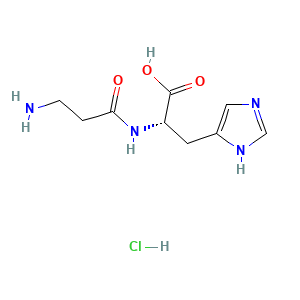 |
| CAS Number | 5852-99-3 |
| Alias / Common Name | Carnosine hydrochloride; L-Carnosine hydrochloride; beta-Alanyl-L-histidine hydrochloride |
| Molecular Formula | C9H15ClN4O3 |
| Molecular Weight | 262.69 g/mol |
| INCI Name | Carnosine HCl |
| Peptide Sequence | β-Ala-L-His·HCl — L-Carnosine hydrochloride salt form (anti-glycation / carbonyl scavenging) |
| Functional Class | Anti-glycation dipeptide HCl salt; carbonyl scavenger; transition-metal chelator; antioxidant imidazole active |
| Purity / Assay | ≥98% (HPLC); confirm by batch COA |
| Appearance | White crystalline powder |
| Solubility / Handling | Freely water-soluble; dissolve in deionised water or aqueous phase at ambient temperature; no co-solvent required |
| pH Stability | Optimal stability at pH 5.0–8.0; the HCl counter-ion may lower dissolution pH — confirm and adjust after incorporation |
| Storage | Store sealed below 25°C in cool, dry, light-protected conditions; follow batch COA and SDS |
> Mechanism & Positioning
Carnosine HCl (L-Carnosine hydrochloride, CAS 5852-99-3) is the hydrochloride counter-ion salt form of L-Carnosine (β-Ala-L-His), providing the same bioactive imidazole dipeptide with a chloride anion counter-ion that may offer formulation advantages in specific pH and compatibility scenarios relative to the free acid form. Published L-Carnosine literature — applicable to the HCl salt as the bioactive component is identical — discusses the β-Ala-His sequence as a multi-mechanism active operating via carbonyl scavenging of reactive RCS (methylglyoxal, malondialdehyde) through Schiff base and Michael addition chemistry at the primary amine and imidazole ring, as well as transition-metal chelation (Cu²⁺, Zn²⁺, Fe²⁺) and direct free radical scavenging through the imidazole ring system. Cell-based fibroblast studies document collagen glycation inhibition, carbonyl-modified protein reduction and oxidative stress protection under AGE challenge conditions. Anti-glycation model data also notes improvement in collagen structural integrity markers in glycative stress assay models at evaluation concentrations, consistent with the primary amine Schiff base capture of carbonyl-collagen adducts.
Based on available in vitro data, Carnosine HCl is positioned for anti-glycation serum, carbonyl-stress age-care concentrate and anti-pollution emulsion concepts. The HCl salt form provides the same Carnosine bioactive sequence as the free acid form; salt selection is determined by formulation pH requirements and counter-ion compatibility. Compare with free L-Carnosine and N-Acetyl Carnosine for the full carnosine-family portfolio from TCS NEXUS S.L.
> Application Concepts
Anti-Glycation Serum Architecture: HCl Salt Form Characteristics
Carnosine HCl dissolves freely in deionised water and aqueous serum bases at 0.1–2.0% (w/w) without co-solvent, and is thermally compatible with hot aqueous phase processing up to 80°C. The HCl counter-ion contribution on dissolution may lower the pH by approximately 0.2–0.5 units at typical evaluation concentrations — measure and adjust pH to the target range (5.0–7.5) after all actives are incorporated. For anti-glycation positioning, combine with hyaluronic acid and niacinamide (2–5%) for simultaneous matrix hydration, carbonyl protection and barrier support. Confirm Carnosine assay retention by HPLC after accelerated stability at 40°C/75% RH.
Carnosine HCl vs Free L-Carnosine: Formulation Considerations
Carnosine HCl (CAS 5852-99-3) and free L-Carnosine (CAS 305-84-0) supply the same β-Ala-L-His bioactive sequence. The key formulation distinction is the counter-ion: the HCl form has a higher molecular weight (262.69 vs 226.23 g/mol for the free acid) and slightly different pH contribution on dissolution. In formulations where a precise final pH is critical (e.g., vitamin C combinations at pH 3.0–4.5), the HCl form may require additional neutralisation. In emulsions where a slight pH reduction is beneficial for preservative efficacy, the HCl counter-ion contribution may be advantageous. Both forms are evaluated at the same 0.1–2.0% use range. Confirm the preferred salt form for your specific formulation base by evaluating pH behaviour and stability in the target system.
Combined Anti-Glycation, Antioxidant and Barrier Systems
Carnosine HCl integrates cleanly into multi-active anti-aging serums alongside Ergothioneine (TAUT-transported mitochondrial antioxidant), Ectoin (extremolyte membrane/protein stabilisation) and matrix-synthesis peptides such as Matrixyl. All are water-soluble and stable at pH 5.0–7.5. The anti-glycation (Carnosine) + antioxidant (Ergothioneine) + barrier (Ectoin) combination addresses three distinct age-related skin stress pathways. For advanced age-care emulsions, further combine with GHK-Cu for LOX-pathway collagen crosslink support. Confirm all actives’ pH alignment and assay retention in the complete formulation before scale-up.
> Handling & Formulation Notes
Dissolve Carnosine HCl in deionised water or the aqueous phase at ambient temperature at 0.1–2.0% (w/w). Freely water-soluble and thermally stable at up to 80°C — compatible with standard hot or cool-down aqueous phase addition. Monitor pH after incorporation: the HCl counter-ion may require minor pH adjustment to reach the target range (5.0–7.5).
Evaluate compatibility with chelating preservatives (EDTA) and strongly acidic actives. Confirm Carnosine assay retention by HPLC after accelerated stability at 40°C/75% RH before production scale-up. The bioactive component is identical to free L-Carnosine — activity data generated for L-Carnosine applies to the HCl salt form at equivalent molar concentrations.
> Supply & Documentation
Carnosine HCl (CAS 5852-99-3) is available from TCS NEXUS S.L. (Valencia, Spain) for B2B cosmetic raw material projects. Standard documentation: COA, TDS, SDS. Sample and bulk quantities are discussed on a per-project basis; contact info@tcspeptides.com to initiate a sourcing review.
TCS NEXUS S.L. supports procurement and formulation teams in Germany, France, Italy, Spain, the United Kingdom, the Netherlands, Belgium, Poland, Sweden and Portugal, as well as international buyers in the United States, Canada, Japan, South Korea, Australia and New Zealand.
> Packaging & Storage
Carnosine HCl is supplied in sealed aluminium foil bags or bulk containers. Minimum quantities and packaging configurations are confirmed per order. Store below 25°C in a cool, dry location, away from moisture and direct light. Follow batch COA and SDS for specific storage and handling conditions.
> FAQ
What is Carnosine HCl?
Carnosine HCl (CAS 5852-99-3) is a cosmetic raw material supplied by TCS NEXUS S.L. (Valencia, Spain) for B2B cosmetic formulators. In cosmetic literature, Carnosine HCl (L-Carnosine hydrochloride) is positioned as a bioavailable, highly water-soluble form of L-Carnosine — evaluated in anti-glycation and antioxidant serums where the HCl salt form provides improved aqueous solubility and pH-compatibility relative to free-base L-Carnosine, making it suited to clear aqueous serum systems. TCS NEXUS S.L. supplies Carnosine HCl as a B2B cosmetic active for anti-ageing and anti-glycation formulation specialists.
What is the CAS number for Carnosine HCl?
The CAS number for Carnosine HCl is 5852-99-3. The INCI name for cosmetic regulatory documentation and CPNP notification is Carnosine HCl; confirm CAS 5852-99-3 and INCI identity against the batch COA when building product files.
How does Carnosine HCl scavenge reactive carbonyls — and why the HCl salt?
Carnosine HCl is the hydrochloride salt of β-Ala-L-His; once dissolved it delivers the same carnosine dipeptide, whose imidazole ring traps reactive carbonyl species (methylglyoxal, glyoxal) to limit AGE crosslinking, while also quenching ROS and chelating metals. The hydrochloride form is supplied for a well-defined, stable, easily weighed crystalline powder with reliable aqueous dissolution.
What use level of Carnosine HCl is typical, and how should it be evaluated?
Rather than quoting one fixed figure, evaluate the use level conservatively — it varies with the formulation system, the claim and your own testing. Because it is the HCl salt, account for the salt in your active-carnosine calculation; we supply pure Carnosine HCl with COA. Contact info@tcspeptides.com to align documentation with your dosing basis.
Which actives pair with Carnosine HCl, and how does the salt affect formula pH?
Carnosine HCl combines with niacinamide, vitamins C/E and other antioxidant and anti-glycation actives. As a hydrochloride it can nudge the local pH slightly downward on dissolution, so buffer and confirm the finished-product pH when building a multi-active system; it is freely water-soluble and enters the aqueous phase directly.
How does Carnosine HCl differ from free L-Carnosine and the other carnosine analogs?
Carnosine HCl and free L-Carnosine are the same active dipeptide; the hydrochloride simply gives a defined, stable, highly water-soluble crystalline salt that some formulators prefer for handling and consistency. It differs from the enzyme-resistant analogs — N-Acetyl Carnosine (acetylated depot form) and Decarboxy Carnosine / Carcinine (decarboxylated, more potent scavenger) — which change the molecule itself rather than just the counter-ion.
What addition temperature is recommended for Carnosine HCl during manufacturing?
Introduce Carnosine HCl during the cool-down phase at temperatures below 80°C; avoid prolonged exposure above this threshold. Standard aqueous or emulsion cool-down protocols are fully compatible with this addition requirement. Confirm thermal stability in the specific manufacturing process with accelerated stability data before committing to production scale.
What pH range keeps Carnosine HCl stable in a finished formula?
Carnosine HCl is stable across roughly pH 4.0–7.0. Since the salt dissolves slightly acidic, verify and, if needed, buffer the finished-product pH after all actives are incorporated, and keep it away from strongly oxidising bases to preserve the imidazole antioxidant activity.
Is Carnosine HCl compatible with other actives in multi-active cosmetic systems?
Carnosine HCl is compatible with standard cosmetic actives at pH 5.0–8.0 in aqueous or emulsion systems. Evaluate combined system pH drift, clarity and assay retention; confirm preservative compatibility. Run accelerated stability testing at 40°C/75% RH before scale-up.
Is Carnosine HCl (INCI) compliant with EU Cosmetics Regulation 1223/2009?
Carnosine HCl is not listed as a restricted, prohibited or regulated substance under EU Cosmetics Regulation 1223/2009 Annexes II–VI. The finished product manufacturer is responsible for the CPSR and CPNP notification. Use CAS 5852-99-3 and INCI name Carnosine HCl consistently in all regulatory documentation; confirm purity and identity against the batch COA.
How should Carnosine HCl be stored?
Store Carnosine HCl sealed below 25°C in a cool, dry location protected from direct light and moisture. Once opened, reseal the container immediately. Follow specific storage and handling conditions stated in the SDS and batch COA. Confirm shelf life for the specific batch before incorporating into production formulations.
What documentation does TCS NEXUS S.L. provide for Carnosine HCl?
TCS NEXUS S.L. provides COA (confirming CAS 5852-99-3 and HPLC purity ≥98% (HPLC)), TDS (Technical Data Sheet) and SDS (Safety Data Sheet) for Carnosine HCl. Additional documentation such as specification sheets and INCI confirmation letters is available on a per-project basis. Contact info@tcspeptides.com to initiate a documentation and sourcing discussion.
What MOQ and sample options are available for Carnosine HCl?
Sample and bulk quantities for Carnosine HCl are confirmed on a per-project basis through TCS NEXUS S.L. Minimum order quantities depend on current stock, packaging configuration and project scope. R&D teams are encouraged to request samples for stability and concentration-range evaluation before bulk planning. Contact info@tcspeptides.com with project specification to begin a sourcing review.
> Technical Support and Samples
Request COA documents, sample availability, or support for custom synthesis.