
Ergothioneine (EGT) (CAS 497-30-3) is supplied by TCS NEXUS S.L. (Valencia, Spain) for European cosmetic formulators, brand R&D teams and B2B buyers reviewing cosmetic antioxidant and amino acid derivative raw material applications. A freely water-soluble thiohistidine derivative, it dissolves directly in aqueous concentrates without co-solvents at pH 5.0–8.0, with cool-down addition below 80°C recommended in standard serum and leave-on manufacturing protocols.
> Technical Specifications
| Product Name | Ergothioneine (EGT) |
|---|---|
| Molecular Structure | 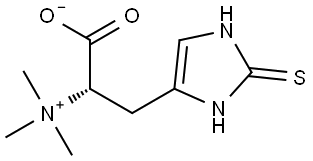 |
| CAS Number | 497-30-3 |
| Alias / Common Name | EGT; L-Ergothioneine; 2-mercaptohistidine trimethylbetaine; Ergotioneina |
| Molecular Formula | C9H15N3O2S |
| Molecular Weight | 229.30 g/mol |
| INCI Name | Ergothioneine |
| Functional Class | Superantioxidant amino acid derivative; TAUT (OCTN1/SLC22A4) transporter-specific; mitochondria-protective; anti-pollution active |
| Purity / Assay | ≥99% (HPLC); confirm by batch COA |
| Appearance | White to off-white crystalline powder |
| Solubility / Handling | Freely water-soluble; dissolve in deionised water or aqueous phase at ambient temperature; stable in solution at pH 5.0–8.0 without co-solvent requirement |
| pH Stability | Exceptional stability across pH 4.0–9.0 in aqueous systems; more stable than glutathione under formulation conditions — does not oxidise readily under normal atmospheric exposure |
| Storage | Store sealed below 25°C in cool, dry, light-protected conditions; relatively stable under normal pharmaceutical storage; follow batch COA and SDS |
> Mechanism & Positioning
Ergothioneine (EGT, CAS 497-30-3) is a naturally occurring thiohistidine betaine amino acid derivative biosynthesised by fungi and mycobacteria and accumulated in human tissues — particularly skin, blood cells and lens — via a dedicated high-affinity transporter, the ergothioneine transporter OCTN1 (encoded by SLC22A4/TAUT). Published Ergothioneine literature discusses the unique molecular basis of its exceptional antioxidant potency: the thione tautomer form (vs thiol in glutathione) is stabilised by delocalisation across the imidazole ring, conferring a reduction potential of −0.06 V vs SHE that enables potent singlet oxygen (¹O₂) quenching, hydroxyl radical (•OH) scavenging and peroxynitrite (ONOO⁻) detoxification. Cell-based keratinocyte and fibroblast studies document mitochondrial protection — Ergothioneine accumulates in mitochondria via TAUT transport and attenuates mitochondrial reactive oxygen species (mROS) output under UV and environmental pollutant challenge. Photoprotection model data also notes 8-OHdG (oxidative DNA damage marker) suppression and pro-inflammatory cytokine (IL-6, TNF-α) release reduction in UVA/UVB-challenged skin cell systems, providing a mechanistically differentiated antioxidant positioning from non-TAUT-transported antioxidants such as ascorbic acid or tocopherol.
Based on available in vitro and ex vivo data, Ergothioneine is positioned for anti-pollution serum, photoprotective leave-on, mitochondrial age-care concentrate and blue-light shield formulation concepts. The TAUT-transporter-specific uptake mechanism differentiates Ergothioneine from Glutathione (GSH) (GPx-pathway substrate) and from Ectoin (extremolyte membrane stabiliser), enabling independent mechanism stacking in anti-pollution and mitochondrial protection multi-active serums.
> Application Concepts
Anti-Pollution and Photoprotective Serum Architecture
Ergothioneine dissolves freely in deionised water, glycerin–water and buffered aqueous serum bases at 0.1–1.0% (w/w) without co-solvent. Unlike glutathione, it is stable in air and does not require nitrogen blanketing during manufacture — making it one of the most formulation-friendly thiohistidine antioxidants. Introduce at any stage of aqueous phase manufacture; stable at temperatures up to 80°C, compatible with pasteurisation or hot aqueous phase processing without significant degradation. Formulate at pH 5.0–8.0; combine with niacinamide (2–5%) for complementary anti-pollution and soothing multi-mechanism positioning. Confirm pH, clarity and EGT assay retention via accelerated stability at 40°C/75% RH before scale-up.
Mitochondrial Protection and Age-Care Concentrate Design
The TAUT-mediated accumulation of Ergothioneine in mitochondria provides a mechanistically unique mitochondrial protection pathway — it is selectively taken up and concentrated by cells expressing the OCTN1 transporter (skin, cornea, liver), providing a targeted intracellular antioxidant supply at the organelle level. For mitochondrial age-care positioning, combine Ergothioneine (0.1–1.0%) with NAD+ or NMN precursors for complementary mitochondrial biogenesis and energy metabolism support, and with Glutathione for GPx-pathway ROS attenuation. All three are water-soluble and stable in the same serum base at pH 5.0–7.0. Confirm combined stability and clarity before committing to production scale.
Blue-Light and UV-After-Care Formats
Ergothioneine’s singlet oxygen quenching and 8-OHdG suppression activity makes it relevant for both UV-after-care and blue-light protection formulations. In blue-light shield products, Ergothioneine (0.1–1.0%) in a lightweight aqueous serum or mist format provides free radical attenuation against HEV light-induced ROS without UV filter regulatory complexity. Combine with L-Carnosine (anti-glycation and metal chelation) and Ectoin (membrane stabilisation) for three-mechanism anti-pollution and photoprotective architecture. For periorbital and eye-area formulations, Ergothioneine is particularly relevant due to TAUT expression in the cornea and periorbital skin — suitable for eye gels and serums at 0.1–0.5%. Confirm final pH (5.0–8.0) and compatibility across all actives before scale-up.
> Handling & Formulation Notes
Dissolve Ergothioneine in deionised water or the aqueous phase at ambient temperature at 0.1–1.0% (w/w). Unlike glutathione, no nitrogen blanketing is required — Ergothioneine is stable in air and can be handled at normal atmospheric conditions. It is stable at processing temperatures up to 80°C, enabling addition to the hot aqueous phase if preferred, though cool-down addition below 45°C is standard for peptide-active serum concepts. Maintain pH within 5.0–8.0.
Evaluate compatibility with strongly oxidising preservative systems and transition metals at high concentrations. Confirm appearance, clarity and EGT assay retention via accelerated stability testing at 40°C/75% RH. Ergothioneine is one of the most thermally stable cosmetic antioxidant raw materials and does not require special oxygen-exclusion manufacturing protocols — making it highly compatible with standard serum and emulsion manufacturing processes.
> Supply & Documentation
Ergothioneine (EGT) (CAS 497-30-3) is available from TCS NEXUS S.L. (Valencia, Spain) for B2B cosmetic raw material projects. Standard documentation: COA, TDS, SDS. Sample and bulk quantities are discussed on a per-project basis; contact info@tcspeptides.com to initiate a sourcing review.
TCS NEXUS S.L. supports procurement and formulation teams in Germany, France, Italy, Spain, the United Kingdom, the Netherlands, Belgium, Poland, Sweden and Portugal, as well as international buyers in the United States, Canada, Japan, South Korea, Australia and New Zealand.
> Packaging & Storage
Ergothioneine (EGT) is supplied in sealed aluminium foil bags or bulk containers. Minimum quantities and packaging configurations are confirmed per order. Store below 25°C in a cool, dry location, away from moisture and direct light. Follow batch COA and SDS for specific storage and handling conditions.
> FAQ
What is Ergothioneine (EGT)?
Ergothioneine (EGT) (CAS 497-30-3) is a cosmetic raw material supplied by TCS NEXUS S.L. (Valencia, Spain) for B2B cosmetic formulators. It is positioned for anti-pollution serum, photoprotective leave-on, mitochondrial age-care concentrate and blue-light shield formulations.
What is the CAS number for Ergothioneine (EGT)?
The CAS number for Ergothioneine (EGT) is 497-30-3. The INCI name for cosmetic regulatory documentation and CPNP notification is Ergothioneine; confirm CAS 497-30-3 and INCI identity against the batch COA when building product files.
How does Ergothioneine protect cells — what is the OCTN1 transporter and antioxidant mechanism?
Ergothioneine (EGT) is a naturally occurring sulphur-containing amino-acid derivative (2-mercaptohistidine trimethylbetaine) regarded as a “longevity vitamin”-class antioxidant. Skin cells actively take it up through a dedicated transporter, OCTN1 (SLC22A4), and concentrate it where oxidative stress is highest, including near mitochondria. There it scavenges reactive oxygen species, hydroxyl radicals and singlet oxygen and chelates metals, giving a targeted, mitochondria-protective, anti-pollution antioxidant profile.
What use level of Ergothioneine is typical, and how should it be evaluated?
Treat the use level as project-specific and establish it conservatively for your base and claim rather than to a fixed figure. We supply pure Ergothioneine with COA for precise pure-material dosing; contact info@tcspeptides.com to align documentation.
Which actives pair with Ergothioneine in an antioxidant, anti-pollution system?
Ergothioneine complements other antioxidants that act in different compartments — vitamin C, vitamin E, and glutathione — and pairs with niacinamide and soothing actives for anti-pollution and age-care positioning. It is water-soluble and unusually stable for a thiol-type antioxidant; confirm combined stability and pH in the finished base.
What makes Ergothioneine different from other thiol antioxidants like glutathione?
Unlike glutathione, whose free thiol oxidises readily, Ergothioneine exists largely as a stable thione tautomer, so it resists auto-oxidation and stays active far longer in a formula — a major practical advantage. It is also unique in having a dedicated cellular transporter (OCTN1) that concentrates it intracellularly. Ergothioneine is freely water-soluble and dissolves directly in the aqueous phase.
What addition temperature is recommended for Ergothioneine (EGT) during manufacturing?
Introduce Ergothioneine (EGT) during the cool-down phase at temperatures below 80°C; avoid prolonged exposure above this threshold. Standard aqueous or emulsion cool-down protocols are fully compatible with this addition requirement. Confirm thermal stability in the specific manufacturing process with accelerated stability data before committing to production scale.
What pH range keeps Ergothioneine stable in a finished formula?
Ergothioneine is stable across a broad range around pH 4.0–7.0 and, thanks to its thione form, tolerates conditions that would oxidise many thiol antioxidants; confirm the finished-product pH after all actives are incorporated.
Is Ergothioneine (EGT) compatible with other actives in multi-active cosmetic systems?
Ergothioneine (EGT) is compatible with standard cosmetic actives at pH 5.0–8.0 in aqueous or emulsion systems. Evaluate combined system pH drift, clarity and assay retention; confirm preservative compatibility. Run accelerated stability testing at 40°C/75% RH before scale-up.
Is Ergothioneine (INCI) compliant with EU Cosmetics Regulation 1223/2009?
Ergothioneine is not listed as a restricted, prohibited or regulated substance under EU Cosmetics Regulation 1223/2009 Annexes II–VI. The finished product manufacturer is responsible for the CPSR and CPNP notification. Use CAS 497-30-3 and INCI name Ergothioneine consistently in all regulatory documentation; confirm purity and identity against the batch COA.
How should Ergothioneine (EGT) be stored?
Store Ergothioneine (EGT) sealed below 25°C in a cool, dry location protected from direct light and moisture. Once opened, reseal the container immediately. Follow specific storage and handling conditions stated in the SDS and batch COA. Confirm shelf life for the specific batch before incorporating into production formulations.
What documentation does TCS NEXUS S.L. provide for Ergothioneine (EGT)?
TCS NEXUS S.L. provides COA (confirming CAS 497-30-3 and HPLC purity ≥99% (HPLC)), TDS (Technical Data Sheet) and SDS (Safety Data Sheet) for Ergothioneine (EGT). Additional documentation such as specification sheets and INCI confirmation letters is available on a per-project basis. Contact info@tcspeptides.com to initiate a documentation and sourcing discussion.
What MOQ and sample options are available for Ergothioneine (EGT)?
Sample and bulk quantities for Ergothioneine (EGT) are confirmed on a per-project basis through TCS NEXUS S.L. Minimum order quantities depend on current stock, packaging configuration and project scope. R&D teams are encouraged to request samples for stability and concentration-range evaluation before bulk planning. Contact info@tcspeptides.com with project specification to begin a sourcing review.
> Technical Support and Samples
Request COA documents, sample availability, or support for custom synthesis.