
L-Balenine (CAS 331-38-4) is supplied by TCS NEXUS S.L. (Valencia, Spain) for European cosmetic formulators, brand R&D teams and B2B buyers reviewing cosmetic peptide raw material applications. A freely water-soluble peptide, it dissolves directly in aqueous concentrates without co-solvents at pH 4.5–7.0, with cool-down addition below 40°C recommended in standard serum and leave-on manufacturing protocols.
> Technical Specifications
| Product Name | L-Balenine |
|---|---|
| Molecular Structure | 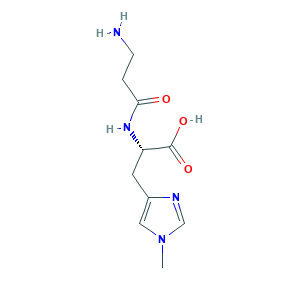 |
| CAS Number | 331-38-4 |
| Alias / Common Name | L-Balenine; β-alanyl-3-methylhistidine; Ophidine; Balenine |
| Molecular Formula | C10H16N4O3 |
| Molecular Weight | 240.3 g/mol |
| INCI Name | Balenine |
| Peptide Sequence | β-Ala-3-methylhistidine — β-alanyl-3-Me-His (3-methylhistidine imidazole dipeptide) |
| Functional Class | Naturally occurring imidazole dipeptide; antioxidant; carbonyl scavenger; anti-glycation active; histidine-containing dipeptide (HCD) class |
| Purity / Assay | ≥98% (HPLC); confirm by batch COA |
| Appearance | White to off-white crystalline powder |
| Solubility / Handling | Freely water-soluble at evaluation concentrations (0.1–2.0%); dissolves directly in deionised water or the aqueous phase without co-solvent. Add during the cool-down phase below 40°C. |
| pH Stability | Optimal stability at pH 4.5–7.0. Confirm stability in the complete formulation base. |
| Storage | Store sealed below 25°C in a cool, dry location protected from direct light, moisture and oxygen. Follow SDS and batch COA conditions. |
> Mechanism & Positioning
L-Balenine is a naturally occurring histidine-containing dipeptide (HCD) belonging to the β-alanyl-imidazole dipeptide class, which includes carnosine and anserine. Its distinctive 3-methylhistidine residue modifies the imidazole pKa profile, providing targeted reactivity in carbonyl-scavenging and metal-chelation at physiological skin pH. Published L-Balenine literature discusses the imidazole ring as the primary reactive site for carbonyl-trapping: nucleophilic addition to reactive carbonyl species (RCS) — methylglyoxal (MGO), glyoxal (GO) and malondialdehyde (MDA) — formed during glycation and lipid peroxidation in the dermis. Cell-based fibroblast glycation studies document quenching of methylglyoxal and reduced advanced glycation endproduct (AGE) accumulation (CML, CEL, crosslinks) following treatment with HCD-class dipeptides including L-Balenine. Metal-chelation model data also notes iron(II) and copper(II) chelation — relevant to Fenton-chemistry-driven oxidative stress suppression in UV-exposed and chronologically aged skin. The combination of direct carbonyl scavenging, AGE inhibition and transition metal chelation positions L-Balenine as a multi-modal antioxidant and anti-glycation active in premium age-care concentrates.
L-Balenine builds complementary antioxidant and anti-glycation systems with L-Anserine (1-methylhistidine HCD, complementary imidazole substitution pattern) and L-Carnosine (unsubstituted β-Ala-His, broadest-spectrum carnosinase substrate). For maximum AGE pathway inhibition in a premium age-care serum, evaluate the three HCD class dipeptides alongside Ergothioneine for TAUT-transporter-mediated intracellular antioxidant support. Contact info@tcspeptides.com with formulation specification.
> Application Concepts
Anti-Glycation Serum and Imidazole Dipeptide Architecture
L-Balenine at 0.1–2.0% dissolves directly in deionised water and is added to the formulation at cool-down below 40°C — a simple addition to aqueous serums, essence concentrates and anti-age cream formulations without co-solvent or pre-dispersion step. It is compatible with standard carbomer and xanthan gum rheology systems at pH 5.0–6.5. For a premium multi-HCD anti-glycation serum, combine L-Balenine with L-Anserine (complementary 1-methylhistidine) and L-Carnosine (unsubstituted His) at overlapping concentration ranges (0.1–1.0% each) within a single aqueous base. Evaluate total HCD concentration compatibility in the preservation system — high-HCD concentrations (> 3% total) may require chelant adjustments (EDTA or phytic acid) for formulation stability.
Carbonyl Scavenging vs Metal Chelation — Two Antioxidant Pathways in One HCD Molecule
Imidazole dipeptides such as L-Balenine are bifunctional antioxidants operating through two distinct pathways: direct carbonyl quenching (nucleophilic imidazole addition to RCS such as MGO and MDA — reducing AGE cross-link formation and protein carbonylation) and transition metal chelation (Fe²⁺/Cu²⁺ complexation — reducing Fenton and Haber-Weiss reaction-driven hydroxyl radical generation). The 3-methylhistidine substitution in L-Balenine shifts the imidazole pKa toward a range that may favour selective RCS reactivity under cosmetic formulation pH conditions. This makes L-Balenine and L-Anserine (1-methylhistidine) structurally complementary even at overlapping concentration ranges — each methylhistidine isomer may engage the carbonyl-scavenging reaction at slightly different reactivity profiles. Evaluate the two-peptide combination in a 0.5% + 0.5% MGO-challenge model before finalising the ratio.
Age-Care, Anti-Glycation and Collagen Preservation Format Applications
Anti-glycation actives address intrinsic and UV-extrinsic ageing convergence: AGE cross-links in dermal collagen and elastin contribute to matrix stiffening and reduced regenerative capacity independent of MMP-driven degradation. L-Balenine at 0.1–2.0% integrates into premium age-care serums, regenerative night concentrates and functional food-derived cosmetic ingredient positioning. For “sugar ageing” or “glycation protection” claim concepts, combine L-Balenine with aminoguanidine-class actives or benfotiamine-equivalent barrier support to target both non-enzymatic and enzymatic AGE pathways. For matrix-repair combination systems, pair with Palmitoyl Tripeptide-1 and Palmitoyl Tetrapeptide-7 (Rigin) for TGF-β matrix synthesis support alongside AGE inhibition.
> Handling & Formulation Notes
Dissolve L-Balenine directly in deionised water or the aqueous phase at target concentrations (0.1–2.0%) without co-solvent or heating. Add to the formulation during cool-down below 40°C. Store stock solutions in nitrogen-blanketed or inert-atmosphere containers to minimise oxidative degradation of the imidazole moiety. Avoid prolonged open-air exposure of bulk powder — reseal immediately after weighing.
Confirm stability of L-Balenine in the complete formulation at 40°C/75% RH for 12 weeks before scale-up. Monitor imidazole ring integrity by HPLC when formulating with strong oxidising agents (high H₂O₂, benzoyl peroxide) or at pH above 8.0. Follow SDS and batch COA for storage and handling; confirm shelf life for the specific batch.
> Supply & Documentation
L-Balenine (CAS 331-38-4) is available from TCS NEXUS S.L. (Valencia, Spain) for B2B cosmetic raw material projects. Standard documentation: COA, TDS, SDS. Sample and bulk quantities are discussed on a per-project basis; contact info@tcspeptides.com to initiate a sourcing review.
TCS NEXUS S.L. supports procurement and formulation teams in Germany, France, Italy, Spain, the United Kingdom, the Netherlands, Belgium, Poland, Sweden and Portugal, as well as international buyers in the United States, Canada, Japan, South Korea, Australia and New Zealand.
> Packaging & Storage
L-Balenine is supplied in sealed aluminium foil bags or bulk containers. Minimum quantities and packaging configurations are confirmed per order. Store below 25°C in a cool, dry location, away from moisture and direct light. Follow batch COA and SDS for specific storage and handling conditions.
> FAQ
What is L-Balenine?
L-Balenine (CAS 331-38-4) is a cosmetic raw material supplied by TCS NEXUS S.L. (Valencia, Spain) for B2B cosmetic formulators. In cosmetic literature, L-Balenine is positioned as a rare carnosinase-resistant imidazole dipeptide antioxidant — evaluated in premium anti-ageing and anti-glycation serums where its N3-methylated histidine ring provides extended metabolic stability and complementary carbonyl-quenching activity relative to L-Anserine and L-Carnosine. TCS NEXUS S.L. supplies L-Balenine (β-Ala-3-Me-His, CAS 331-38-4) as a B2B cosmetic active for anti-ageing formulation specialists.
What is the CAS number for L-Balenine?
The CAS number for L-Balenine is 331-38-4. The INCI name for cosmetic regulatory documentation and CPNP notification is Balenine; confirm CAS 331-38-4 and INCI identity against the batch COA when building product files.
How does L-Balenine act as an antioxidant — what does the 3-methyl group do?
L-Balenine, also called ophidine (β-alanyl-3-methyl-L-histidine), is a naturally occurring histidine-containing dipeptide (HCD) related to carnosine and anserine, methylated at position 3 of the imidazole ring. Like the rest of the family it scavenges reactive carbonyls and free radicals and chelates metals; the 3-methyl position gives it its own imidazole pKa and antioxidant profile within the HCD class.
What use level of L-Balenine is typical, and how should it be evaluated?
Because the effective level shifts with formulation, claim and protocol, evaluate it conservatively and confirm it in your own trials rather than assuming a fixed figure. L-Balenine is a rarer HCD supplied as pure material with COA; contact info@tcspeptides.com to align documentation with your target.
Which actives pair with L-Balenine in an antioxidant HCD blend?
L-Balenine combines with its sister imidazole dipeptides L-Carnosine and L-Anserine and with antioxidants such as niacinamide and vitamin E for a naturally-inspired HCD antioxidant system. It is water-soluble; confirm combined stability and pH in the finished base.
How does L-Balenine differ from L-Carnosine and L-Anserine?
The three differ only in imidazole methylation: L-Carnosine has none, L-Anserine is 1-methylated, and L-Balenine (ophidine) is 3-methylated. The methyl position shifts pKa and fine-tunes antioxidant behaviour while the β-alanyl-histidine scavenging core is shared. L-Balenine is the rarest of the three and is freely water-soluble.
What addition temperature is recommended for L-Balenine during manufacturing?
Introduce L-Balenine during the cool-down phase at temperatures below 40°C; avoid prolonged exposure above this threshold. Standard aqueous or emulsion cool-down protocols are fully compatible with this addition requirement. Confirm thermal stability in the specific manufacturing process with accelerated stability data before committing to production scale.
What pH range keeps L-Balenine stable in a finished formula?
L-Balenine is stable across roughly pH 4.0–7.0; confirm the finished-product pH after all actives are incorporated and avoid strongly oxidising bases so the imidazole antioxidant activity is preserved.
Is L-Balenine compatible with other actives in multi-active cosmetic systems?
L-Balenine is compatible with standard cosmetic actives at pH 4.5–7.0 in aqueous or emulsion systems. Evaluate combined system pH drift, clarity and assay retention; confirm preservative compatibility. Run accelerated stability testing at 40°C/75% RH before scale-up.
Is Balenine (INCI) compliant with EU Cosmetics Regulation 1223/2009?
Balenine is not listed as a restricted, prohibited or regulated substance under EU Cosmetics Regulation 1223/2009 Annexes II–VI. The finished product manufacturer is responsible for the CPSR and CPNP notification. Use CAS 331-38-4 and INCI name Balenine consistently in all regulatory documentation; confirm purity and identity against the batch COA.
How should L-Balenine be stored?
Store L-Balenine sealed below 25°C in a cool, dry location protected from direct light and moisture. Once opened, reseal the container immediately. Follow specific storage and handling conditions stated in the SDS and batch COA. Confirm shelf life for the specific batch before incorporating into production formulations.
What documentation does TCS NEXUS S.L. provide for L-Balenine?
TCS NEXUS S.L. provides COA (confirming CAS 331-38-4 and HPLC purity ≥98% (HPLC)), TDS (Technical Data Sheet) and SDS (Safety Data Sheet) for L-Balenine. Additional documentation such as specification sheets and INCI confirmation letters is available on a per-project basis. Contact info@tcspeptides.com to initiate a documentation and sourcing discussion.
What MOQ and sample options are available for L-Balenine?
Sample and bulk quantities for L-Balenine are confirmed on a per-project basis through TCS NEXUS S.L. Minimum order quantities depend on current stock, packaging configuration and project scope. R&D teams are encouraged to request samples for stability and concentration-range evaluation before bulk planning. Contact info@tcspeptides.com with project specification to begin a sourcing review.
> Technical Support and Samples
Request COA documents, sample availability, or support for custom synthesis.