
Hexapeptide-2 (Melanostatine 2) (CAS 87616-84-0) is supplied by TCS NEXUS S.L. (Valencia, Spain) for European cosmetic formulators, brand R&D teams and B2B buyers reviewing cosmetic peptide raw material applications. A freely water-soluble peptide, it dissolves directly in aqueous concentrates without co-solvents at pH 4.5–7.0, with cool-down addition below 40°C recommended in standard serum and leave-on manufacturing protocols.
> Technical Specifications
| Product Name | Hexapeptide-2 (Melanostatine 2) |
|---|---|
| Molecular Structure | 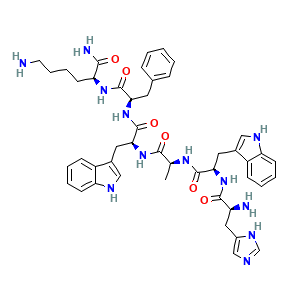 |
| CAS Number | 87616-84-0 |
| Alias / Common Name | Hexapeptide-2; Melanostatine 2; MC1R-modulating brightening hexapeptide |
| Molecular Formula | C46H56N12O6 |
| Molecular Weight | 873.0 g/mol |
| INCI Name | Hexapeptide-2 |
| Peptide Sequence | Tyr-Arg-Ser-Arg-Lys-Val-NH2 — MC1R-competitive hexapeptide biomimetic |
| Functional Class | Synthetic hexapeptide; MC1R (melanocortin-1 receptor) modulator; melanogenesis pathway active; brightening and pigmentation-control peptide |
| Purity / Assay | ≥98% (HPLC); confirm by batch COA |
| Appearance | White to off-white powder |
| Solubility / Handling | Freely water-soluble; dissolves readily in deionised water or the aqueous phase at evaluation concentrations (0.001–0.01%) without co-solvent. Add during the cool-down phase below 40°C. |
| pH Stability | Optimal stability at pH 4.5–7.0. Confirm stability in the complete formulation base. |
| Storage | Store sealed below 25°C in a cool, dry location protected from direct light and moisture. Follow SDS and batch COA conditions. |
> Mechanism & Positioning
Hexapeptide-2 (Melanostatine 2) is a synthetic hexapeptide designed to modulate melanogenesis through the MC1R (melanocortin-1 receptor) signalling axis. Published Hexapeptide-2 literature discusses competitive modulation at MC1R — the primary α-MSH receptor on melanocytes that activates adenylate cyclase, raises cAMP and triggers MITF (microphthalmia-associated transcription factor) upregulation, which in turn drives tyrosinase, TYRP1 and TYRP2 gene expression and melanin synthesis. Cell-based melanocyte studies document reduced cAMP accumulation, MITF downregulation and attenuated tyrosinase activity following Hexapeptide-2 treatment, consistent with MC1R pathway modulation. Melanin synthesis inhibition model data also notes reduced melanin transfer to keratinocytes in organotypic co-culture assays. This mechanism is distinct from tyrosinase substrate competition (kojic acid, arbutin) and acts upstream at the receptor-signalling level, making it a complementary brightening active in multi-mechanism pigmentation systems.
Hexapeptide-2 builds multi-pathway brightening systems with Tetrapeptide-30 (PKEK) — which modulates the ET-1/EDNRB axis for a complementary UV-triggered paracrine pathway — and with tyrosinase-targeting actives such as arbutin or tranexamic acid for substrate-level melanin inhibition. For comprehensive photoprotection-oriented brightening, add Ergothioneine for antioxidant support against UV-triggered melanogenic signalling. Contact info@tcspeptides.com with formulation specification.
> Application Concepts
Brightening Serum and MC1R-Modulating Hexapeptide Architecture
Hexapeptide-2 at 0.001–0.01% dissolves directly in the aqueous phase and is added at cool-down below 40°C, making it a straightforward addition to clear brightening serums, toner-serum hybrids and spot-concentrate formats. At pH 5.0–6.5, it is compatible with standard carbomer, hyaluronic acid and niacinamide brightening bases. For a clean dual-peptide brightening serum, combine Hexapeptide-2 (MC1R / melanocyte signalling) with Tetrapeptide-30 (PKEK) (ET-1 / keratinocyte-melanocyte paracrine axis) to address two independent activation pathways in the melanogenesis cascade within a single clear aqueous product.
MC1R Pathway vs ET-1/EDNRB Pathway — Two Distinct Melanogenesis Activation Axes
Skin pigmentation is triggered by multiple extracellular signals converging on the melanocyte: α-MSH acting on MC1R (UV-induced, via keratinocyte POMC secretion) and ET-1 acting on EDNRB (also UV-triggered, via keratinocyte endothelin secretion). Both raise cAMP and activate MITF — but through different ligand-receptor pairs, meaning they can be activated independently. Hexapeptide-2 targets the α-MSH/MC1R axis; Tetrapeptide-30 (PKEK) modulates the ET-1/EDNRB axis. Combining both peptides provides complementary, non-redundant pathway coverage — blocking both major paracrine activation routes to MITF — which is more complete than any single-mechanism brightening active alone. Evaluate each peptide at established concentrations individually before combining.
Post-UV Brightening, Melasma Support and Even-Tone Concentrate Formats
MC1R-modulating actives are relevant across three premium brightening market segments: post-UV brightening serums (addressing UV-triggered α-MSH/MC1R melanocyte activation), melasma-support concentrates (chronic MITF overactivation), and general even-tone daily serums. Hexapeptide-2 at 0.001–0.01% integrates cleanly into fragrance-free brightening serums formulated at pH 5.5–6.5. For melasma-support positioning, evaluate Hexapeptide-2 alongside tranexamic acid (2–3%) or niacinamide (4–5%) as complementary mechanisms targeting keratinocyte-melanocyte communication and melanosome transfer respectively. Confirm formulation stability and peptide assay retention at 40°C/75% RH across all actives before scale-up.
> Handling & Formulation Notes
Dissolve Hexapeptide-2 directly in deionised water or the aqueous phase at target concentrations (0.001–0.01%) without co-solvent or pre-dispersion step. Add the aqueous solution at cool-down below 40°C. For concentrations above 0.05%, prepare a 1% aqueous stock solution and add the calculated aliquot to the batch at cool-down. No PG pre-dispersion or special dissolution step is required at evaluation concentrations.
Confirm stability of Hexapeptide-2 in the complete brightening formulation at 40°C/75% RH for 12 weeks before scale-up. Formulate at pH 4.5–7.0; a brightening serum at pH 5.5–6.5 provides optimal Hexapeptide-2 stability. Monitor for co-ingredient interactions when combining with strong reducing agents (ascorbic acid > 5%) — evaluate pH and peptide stability together. Follow SDS and batch COA for storage and handling. EDTA at ≤0.1% is compatible as a chelating buffer; avoid strong oxidising agents (H₂O₂ ≥1%, benzoyl peroxide) and high-pH systems above pH 8.0.
> Supply & Documentation
Hexapeptide-2 (Melanostatine 2) (CAS 87616-84-0) is available from TCS NEXUS S.L. (Valencia, Spain) for B2B cosmetic raw material projects. Standard documentation: COA, TDS, SDS. Sample and bulk quantities are discussed on a per-project basis; contact info@tcspeptides.com to initiate a sourcing review.
TCS NEXUS S.L. supports procurement and formulation teams in Germany, France, Italy, Spain, the United Kingdom, the Netherlands, Belgium, Poland, Sweden and Portugal, as well as international buyers in the United States, Canada, Japan, South Korea, Australia and New Zealand.
> Packaging & Storage
Hexapeptide-2 (Melanostatine 2) is supplied in sealed aluminium foil bags or bulk containers. Minimum quantities and packaging configurations are confirmed per order. Store below 25°C in a cool, dry location, away from moisture and direct light. Follow batch COA and SDS for specific storage and handling conditions.
> FAQ
What is Hexapeptide-2 (Melanostatine 2)?
Hexapeptide-2 (Melanostatine 2) (CAS 87616-84-0) is a cosmetic raw material supplied by TCS NEXUS S.L. (Valencia, Spain) for B2B cosmetic formulators. In cosmetic literature, Hexapeptide-2 (Melanostatine 2) is positioned as a melanocortin receptor-blocking brightening peptide that acts at the melanocyte receptor level — evaluated in even-tone serums and anti-hyperpigmentation formulations targeting MC1R-driven melanin overproduction in UV-stimulated and post-inflammatory conditions. TCS NEXUS S.L. supplies Hexapeptide-2 as a pure synthetic hexapeptide for B2B cosmetic formulators.
What is the CAS number for Hexapeptide-2 (Melanostatine 2)?
The CAS number for Hexapeptide-2 (Melanostatine 2) is 87616-84-0. The INCI name for cosmetic regulatory documentation and CPNP notification is Hexapeptide-2; confirm CAS 87616-84-0 and INCI identity against the batch COA when building product files.
How does Melanostatine control pigmentation — what is the MC1R / α-MSH mechanism?
Hexapeptide-2 (Melanostatine 2) is a hexapeptide (Tyr-Arg-Ser-Arg-Lys-Val) that acts upstream in melanogenesis. It is described as competing with α-MSH (alpha-melanocyte-stimulating hormone) at the melanocortin-1 receptor (MC1R) on melanocytes; by limiting α-MSH signalling it reduces the downstream activation of tyrosinase and melanin production. Because it works at the receptor-signalling step rather than on the tyrosinase enzyme itself, it targets an earlier point in the pigmentation cascade.
What use level of Melanostatine is typical, and does the pure vs trade-solution basis matter?
Use level is formulation- and claim-specific, so set it conservatively for your specific system rather than to a single figure; the TDS references a low fractional-percent evaluation window as a starting point. Melanostatine is sold both as a diluted trade solution and as pure peptide; we supply the pure material with COA for precise pure-peptide dosing. Contact info@tcspeptides.com to align documentation with your dosing basis.
Which actives pair with Melanostatine in a brightening formula?
Because Melanostatine acts at the MC1R signalling step, it complements brighteners that work further down the pigmentation pathway: tyrosinase-focused actives such as Glutathione (GSH), alpha-arbutin and kojic acid, plus niacinamide (which limits melanosome transfer) and vitamin C. Combining an upstream receptor modulator with downstream tyrosinase and transfer inhibitors is the rationale for multi-target even-tone systems. All are water-soluble; keep the system within pH 4.5–7.0 and confirm combined stability.
How does Melanostatine differ from tyrosinase-inhibiting brighteners?
Most cosmetic brighteners — arbutin, kojic acid, and to a large extent Glutathione — act on tyrosinase, the enzyme that builds melanin. Hexapeptide-2 (Melanostatine 2) instead works one step earlier, at the MC1R receptor that receives the α-MSH “make melanin” signal. Targeting different points means the two approaches can be layered rather than being interchangeable. Melanostatine is freely water-soluble and dissolves directly in the aqueous phase.
How should Melanostatine be incorporated during manufacturing?
Hexapeptide-2 is freely water-soluble at evaluation concentrations — dissolve it directly in deionised water or the aqueous phase without a co-solvent, and add it during the cool-down phase below 40°C to avoid heat degradation. The water-soluble profile suits clear serums, essences and eye products; confirm clarity and finished pH before scale-up.
What pH range keeps Melanostatine stable in a brightening formula?
Hexapeptide-2 (Melanostatine 2) is most stable at pH 4.5–7.0, which overlaps well with common brightening actives such as niacinamide and alpha-arbutin. Confirm the finished-product pH after all actives are incorporated, and check compatibility where the base also carries low-pH actives such as vitamin C.
Is Hexapeptide-2 (Melanostatine 2) compatible with other actives in multi-active cosmetic systems?
Hexapeptide-2 (Melanostatine 2) is compatible with standard cosmetic actives at pH 4.5–7.0 in aqueous or emulsion systems. Evaluate combined system pH drift, clarity and assay retention; confirm preservative compatibility. Run accelerated stability testing at 40°C/75% RH before scale-up.
Is Hexapeptide-2 (INCI) compliant with EU Cosmetics Regulation 1223/2009?
Hexapeptide-2 is not listed as a restricted, prohibited or regulated substance under EU Cosmetics Regulation 1223/2009 Annexes II–VI. The finished product manufacturer is responsible for the CPSR and CPNP notification. Use CAS 87616-84-0 and INCI name Hexapeptide-2 consistently in all regulatory documentation; confirm purity and identity against the batch COA.
How should Hexapeptide-2 (Melanostatine 2) be stored?
Store Hexapeptide-2 (Melanostatine 2) sealed below 25°C in a cool, dry location protected from direct light and moisture. Once opened, reseal the container immediately. Follow specific storage and handling conditions stated in the SDS and batch COA. Confirm shelf life for the specific batch before incorporating into production formulations.
What documentation does TCS NEXUS S.L. provide for Hexapeptide-2 (Melanostatine 2)?
TCS NEXUS S.L. provides COA (confirming CAS 87616-84-0 and HPLC purity ≥98% (HPLC)), TDS (Technical Data Sheet) and SDS (Safety Data Sheet) for Hexapeptide-2 (Melanostatine 2). Additional documentation such as specification sheets and INCI confirmation letters is available on a per-project basis. Contact info@tcspeptides.com to initiate a documentation and sourcing discussion.
What MOQ and sample options are available for Hexapeptide-2 (Melanostatine 2)?
Sample and bulk quantities for Hexapeptide-2 (Melanostatine 2) are confirmed on a per-project basis through TCS NEXUS S.L. Minimum order quantities depend on current stock, packaging configuration and project scope. R&D teams are encouraged to request samples for stability and concentration-range evaluation before bulk planning. Contact info@tcspeptides.com with project specification to begin a sourcing review.
> Technical Support and Samples
Request COA documents, sample availability, or support for custom synthesis.