
Acetyl Tetrapeptide-5 (Eyeseryl) (CAS 820959-17-9) is supplied by TCS NEXUS S.L. (Valencia, Spain) for European cosmetic formulators, brand R&D teams and B2B buyers reviewing cosmetic peptide raw material applications. A freely water-soluble peptide, it dissolves directly in aqueous concentrates without co-solvents at pH 5.0–7.5, with cool-down addition below 45°C recommended in standard serum and leave-on manufacturing protocols.
> Technical Specifications
| Product Name | Acetyl Tetrapeptide-5 (Eyeseryl) |
|---|---|
| Molecular Structure | 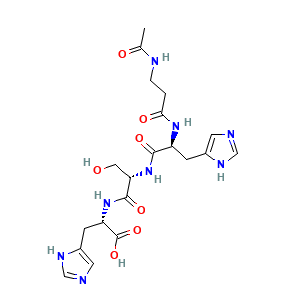 |
| CAS Number | 820959-17-9 |
| Alias / Common Name | Acetyl Tetrapeptide-5; Eyeseryl |
| Molecular Formula | C20H28N8O7 |
| Molecular Weight | 492.5 g/mol |
| INCI Name | Acetyl Tetrapeptide-5 |
| Peptide Sequence | Ac-β-Ala-His-Ser-His-OH — periorbital anti-oedema tetrapeptide (ACE modulation / capillary permeability / anti-glycation) |
| Functional Class | Synthetic tetrapeptide; periorbital anti-puffiness active; ACE/capillary permeability modulator; anti-glycation active |
| Purity / Assay | ≥98% (HPLC); confirm by batch COA |
| Appearance | White to off-white powder |
| Solubility / Handling | Freely water-soluble; dissolve in deionised water or aqueous phase at ambient temperature; no co-solvent required |
| pH Stability | Optimal stability at pH 5.0–7.5; confirm in the complete formulation after all actives |
| Storage | Store sealed below 25°C in cool, dry, light-protected conditions; follow batch COA and SDS |
> Mechanism & Positioning
Acetyl Tetrapeptide-5 (Eyeseryl, Ac-β-Ala-His-Ser-His, CAS 820959-17-9) is a synthetic tetrapeptide designed for periorbital anti-puffiness and dark circle reduction applications, targeting the vascular and glycative stress mechanisms underlying lower eyelid oedema and hypo-perfusion. Published Acetyl Tetrapeptide-5 literature discusses angiotensin-converting enzyme (ACE) pathway modulation: the His-Ser-His motif has homology to ACE inhibitory sequences, and ACE-related modulation of bradykinin and vasopressin signalling influences capillary permeability in the fine dermal capillary network beneath the lower eyelid. Reduced capillary wall permeability attenuates fluid transudation into the hypodermis, addressing a primary mechanism of periorbital puffiness. Cell-based periorbital studies document glycation inhibition of elastin — elastin AGE-crosslinks reduce tissue elasticity and impair lymphatic drainage in the delicate periorbital dermis. Anti-puffiness model data also notes hyaluronic acid degradation reduction under glycative challenge conditions, supporting periorbital dermis integrity and firmness at evaluated peptide concentrations.
Based on available in vitro data, Acetyl Tetrapeptide-5 is positioned for periorbital anti-puffiness eye gel, eye contour cream-gel and eye-patch hydrogel concepts where capillary permeability modulation and anti-glycation are the primary mechanistic directions. For comprehensive periorbital positioning, Acetyl Tetrapeptide-5 (ACE/anti-glycation) may be combined with Dipeptide-2 (Val-Trp) for complementary lymphatic drainage support — the two peptides address distinct anti-puffiness mechanisms and can be combined in the same periorbital concentrate at their respective evaluation concentrations.
> Application Concepts
Periorbital Anti-Puffiness Eye Gel Architecture
Acetyl Tetrapeptide-5 (Eyeseryl) is freely water-soluble at 0.001–0.01% (w/w) in standard eye-gel and eye-cream-gel aqueous bases, dissolving without co-solvent or glycol pre-mix. Introduce during the cool-down phase below 45°C; standard aqueous serum and gel cool-down protocols are compatible. For periorbital gel formulations, combine with caffeine (0.5–2.0%, adenosine-receptor drainage) and hyaluronic acid (low MW, 5–50 kDa, for rapid periorbital penetration) for a complementary multi-mechanism anti-puffiness gel concentrate. Evaluate pH within 5.0–7.0 suitable for the sensitive periorbital application zone. Confirm peptide assay retention via HPLC after accelerated stability at 40°C/75% RH before scale-up to production batches.
Two-Mechanism Periorbital Combination: Eyeseryl + Dipeptide-2
Acetyl Tetrapeptide-5 (ACE capillary permeability modulation) and Dipeptide-2 (Val-Trp, lymphatic drainage / bradykinin pathway) address complementary periorbital anti-puffiness mechanisms: Eyeseryl reduces capillary leakage and fluid transudation; Dipeptide-2 supports lymphatic vessel toning and fluid drainage in the periorbital hypodermis. Both are freely water-soluble and compatible at pH 5.0–7.0 in the same aqueous eye-gel base. Evaluate the combination at 0.001–0.01% each; confirm combined stability and pH alignment. For premium periorbital positioning, further incorporate niacinamide for microcirculation support and anti-dark-circle activity. Confirm combined stability in the periorbital base before scale-up.
Eye Contour Cream-Gel and Hydrogel Patch Formats
The lightweight aqueous solubility profile of Acetyl Tetrapeptide-5 supports integration into transparent eye-contour gels, cream-gel hybrid formats (carbomer/xanthan gel in o/w emulsion) and single-use hydrogel patches for periorbital delivery. In hydrogel patches, the peptide is loaded into the patch matrix (hyaluronate gel or alginate) at 0.001–0.01% alongside caffeine, Dipeptide-2 and hyaluronic acid for a comprehensive periorbital treatment patch product. Patch format provides prolonged periorbital contact time — advantageous for hydrophilic peptides that require residence time for capillary-level absorption. Evaluate addition temperature below 45°C during patch matrix preparation; confirm pH at 5.5–7.0 for periorbital tolerance. Run accelerated stability at 40°C/75% RH in the patch matrix format.
> Handling & Formulation Notes
Dissolve Acetyl Tetrapeptide-5 (Eyeseryl) in deionised water or the aqueous phase at ambient temperature at 0.001–0.01% (w/w). Freely water-soluble at these evaluation concentrations — no co-solvent required. Introduce during the cool-down phase below 45°C; standard aqueous periorbital gel and serum manufacturing protocols are compatible. Maintain pH within 5.0–7.5.
Evaluate compatibility with chelating agents (EDTA) and other periorbital actives at the target pH range. The His residues in the tetapeptide sequence can interact with transition metals — evaluate chelation impact on formulation colour and stability. Confirm peptide assay retention by HPLC after accelerated stability at 40°C/75% RH before production. Contact info@tcspeptides.com for periorbital formulation-specific evaluation guidance.
> Supply & Documentation
Acetyl Tetrapeptide-5 (Eyeseryl) (CAS 820959-17-9) is available from TCS NEXUS S.L. (Valencia, Spain) for B2B cosmetic raw material projects. Standard documentation: COA, TDS, SDS. Sample and bulk quantities are discussed on a per-project basis; contact info@tcspeptides.com to initiate a sourcing review.
TCS NEXUS S.L. supports procurement and formulation teams in Germany, France, Italy, Spain, the United Kingdom, the Netherlands, Belgium, Poland, Sweden and Portugal, as well as international buyers in the United States, Canada, Japan, South Korea, Australia and New Zealand.
> Packaging & Storage
Acetyl Tetrapeptide-5 (Eyeseryl) is supplied in sealed aluminium foil bags or bulk containers. Minimum quantities and packaging configurations are confirmed per order. Store below 25°C in a cool, dry location, away from moisture and direct light. Follow batch COA and SDS for specific storage and handling conditions.
> FAQ
What is Acetyl Tetrapeptide-5 (Eyeseryl)?
Acetyl Tetrapeptide-5 (Eyeseryl) (CAS 820959-17-9) is a cosmetic raw material supplied by TCS NEXUS S.L. (Valencia, Spain) for B2B cosmetic formulators. In cosmetic literature, Acetyl Tetrapeptide-5 (Eyeseryl) is positioned as the principal anti-puffiness active for periorbital formulations — evaluated for its ability to reduce eye-bag swelling by inhibiting angiotensin-converting enzyme (ACE)-dependent vascular permeability in the thin periorbital dermis where fluid accumulation drives visible puffiness. TCS NEXUS S.L. supplies Acetyl Tetrapeptide-5 as a B2B active for formulators developing eye-contour serums and creams.
What is the CAS number for Acetyl Tetrapeptide-5 (Eyeseryl)?
The CAS number for Acetyl Tetrapeptide-5 (Eyeseryl) is 820959-17-9. The INCI name for cosmetic regulatory documentation and CPNP notification is Acetyl Tetrapeptide-5; confirm CAS 820959-17-9 and INCI identity against the batch COA when building product files.
How does Eyeseryl reduce under-eye puffiness — what is the ACE / capillary mechanism?
Acetyl Tetrapeptide-5 (Eyeseryl) is a tetrapeptide (Ac-β-Ala-His-Ser-His) developed for periorbital puffiness. It is described as modulating angiotensin-converting enzyme (ACE) activity and reducing capillary permeability, limiting the fluid accumulation behind under-eye bags, while its anti-glycation activity helps preserve elastin and collagen elasticity in the thin periorbital skin. This drainage-and-elasticity focus sets it apart from the neuromuscular expression-line peptides.
What use level of Eyeseryl is typical, and does the pure vs trade-solution basis matter?
There is no one-size-fits-all dose: establish the use level conservatively for your specific base and claim rather than copying a fixed number. Acetyl Tetrapeptide-5 is sold both as a diluted trade solution and as pure peptide; we supply the pure material with COA so you can dose precisely on a pure-peptide basis. Contact info@tcspeptides.com to align documentation with your dosing basis.
Which actives pair with Eyeseryl in an eye-contour formula?
Eyeseryl pairs with periorbital actives that target complementary parts of the eye area: Dipeptide-2 (Val-Trp) for drainage support, caffeine (typically 0.5–2%) for microcirculation, and niacinamide for barrier and tone. All are water-soluble; keep the eye-contour system within pH 5.0–7.5 and confirm combined stability and comfort for the delicate eye area.
How does Eyeseryl differ from Dipeptide-2 for under-eye bags?
Both are water-soluble anti-puffiness peptides used around the eye, and they are often combined because they act differently. Acetyl Tetrapeptide-5 (Eyeseryl) works around ACE modulation, capillary permeability and anti-glycation to limit fluid build-up, whereas Dipeptide-2 (Val-Trp) supports lymphatic clearance of fluid that has already accumulated. Using them together addresses both fluid formation and its drainage in a periorbital treatment.
How should Eyeseryl be incorporated into an eye-contour gel or serum?
Acetyl Tetrapeptide-5 is freely water-soluble — dissolve it directly in deionised water or the aqueous phase at ambient temperature, with no co-solvent needed, and add it during the cool-down phase below 45°C. The water-soluble profile suits lightweight eye-contour gels, roll-on serums and hydrogel patches; confirm clarity and finished pH before scale-up.
What pH range keeps Eyeseryl stable in an eye-area formula?
Acetyl Tetrapeptide-5 is most stable at pH 5.0–7.5, a range well suited to gentle eye-area products. Confirm the finished-product pH after all actives are incorporated, and pay particular attention to mildness given the sensitivity of periorbital skin.
What claim direction is Eyeseryl positioned for around the eyes?
Its anti-oedema and anti-glycation profile positions Acetyl Tetrapeptide-5 for under-eye-bag, puffiness and morning-fluid claim directions in eye-contour gels, creams and patches, often alongside drainage and microcirculation actives. Keep claims within EU cosmetic boundaries and substantiate them with your own periorbital use and stability testing.
Is Acetyl Tetrapeptide-5 (INCI) compliant with EU Cosmetics Regulation 1223/2009?
Acetyl Tetrapeptide-5 is not listed as a restricted, prohibited or regulated substance under EU Cosmetics Regulation 1223/2009 Annexes II–VI. The finished product manufacturer is responsible for the CPSR and CPNP notification. Use CAS 820959-17-9 and INCI name Acetyl Tetrapeptide-5 consistently in all regulatory documentation; confirm purity and identity against the batch COA.
How should Acetyl Tetrapeptide-5 (Eyeseryl) be stored?
Store Acetyl Tetrapeptide-5 (Eyeseryl) sealed below 25°C in a cool, dry location protected from direct light and moisture. Once opened, reseal the container immediately. Follow specific storage and handling conditions stated in the SDS and batch COA. Confirm shelf life for the specific batch before incorporating into production formulations.
What documentation does TCS NEXUS S.L. provide for Acetyl Tetrapeptide-5 (Eyeseryl)?
TCS NEXUS S.L. provides COA (confirming CAS 820959-17-9 and HPLC purity ≥98% (HPLC)), TDS (Technical Data Sheet) and SDS (Safety Data Sheet) for Acetyl Tetrapeptide-5 (Eyeseryl). Additional documentation such as specification sheets and INCI confirmation letters is available on a per-project basis. Contact info@tcspeptides.com to initiate a documentation and sourcing discussion.
What MOQ and sample options are available for Acetyl Tetrapeptide-5 (Eyeseryl)?
Sample and bulk quantities for Acetyl Tetrapeptide-5 (Eyeseryl) are confirmed on a per-project basis through TCS NEXUS S.L. Minimum order quantities depend on current stock, packaging configuration and project scope. R&D teams are encouraged to request samples for stability and concentration-range evaluation before bulk planning. Contact info@tcspeptides.com with project specification to begin a sourcing review.
> Technical Support and Samples
Request COA documents, sample availability, or support for custom synthesis.