
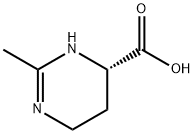
Si trabaja con formulaciones para piel sensible, probablemente haya oido hablar de la ectoina. Lo que quiza no sepa es lo bien documentada que esta esta molecula. La ectoina es un derivado ciclico de aminoacido (1,4,5,6-tetrahydro-2-methyl-4-pyrimidinecarboxylic acid) producido de forma natural por bacterias extremofilas que sobreviven en lagos salados, fuentes termales y desiertos. El mismo mecanismo de estructuracion del agua que mantiene vivas a esas bacterias tambien protege las celulas de la piel humana del estres ambiental.
Como Funciona la Ectoina y Que Dicen los Datos
Ectoin is a kosmotrope. It organizes water molecules into a tight hydration shell around proteins and cell membranes. This is not marketing language; it is physical chemistry. The practical result for skin:
- Barrier function: In a 28-day clinical study (n=20, randomized, vehicle-controlled), 1% ectoin reduced transepidermal water loss (TEWL) by 25.4% and increased skin hydration by 200% (corneometer) compared to baseline. The vehicle alone showed only a 7% hydration improvement.
- UV protection: Ectoin at 2% in a cream base reduced UV-induced Langerhans cell depletion by approximately 92% in a human skin model. It does not absorb UV. It protects cells from the downstream damage.
- Anti-inflammation: In keratinocyte cultures exposed to UVA, ectoin (0.5 mM) suppressed IL-6 and TNF-alpha release by 30-40%. This makes it genuinely useful for post-procedure or rosacea-prone skin.
- Pollution defense: In vitro studies show ectoin reduces particulate-matter-induced mitochondrial damage in keratinocytes by about 55% at 1 mM concentration.
We think ectoin is one of the most undervalued actives available today. The data quality is closer to pharmaceutical standards than typical cosmetic claims, yet it remains affordable and easy to formulate.
Guia de Formulacion
- Recommended use level: 0.5-2.0% in final product. Most clinical data is at 1-2%.
- Addition stage: Can be added hot or cold. Ectoin is thermally stable up to 100 degrees C. This is a major practical advantage over heat-sensitive peptides.
- pH range: Stable from pH 3.0 to 10.0. No issues in typical cosmetic formulations.
- Solubility: Freely soluble in water (over 500 g/L at 25 degrees C). Practically insoluble in oils.
- Compatibility: Compatible with virtually everything: surfactants, preservatives, other actives. No known incompatibilities. Works well alongside niacinamide, hyaluronic acid, ceramides, and peptides.
- Sensory: Neutral taste, no odor, does not affect product texture or viscosity.
- Regulatory: Listed in EU CosIng database. INCI: Ectoin. Not restricted.
Preguntas Frecuentes
Es la ectoina lo mismo que la hidroxiectoina?
No. Hydroxyectoin (5-hydroxyectoin) is a related molecule with similar properties but a different efficacy profile. Our product is ectoin (non-hydroxylated), which has the majority of published clinical data.
Puede la ectoina reemplazar al acido hialuronico en mi formula?
They work differently. HA is a humectant that draws and holds water in the stratum corneum. Ectoin protects cell membranes and proteins from stress damage. The combination is stronger than either alone: ectoin for protection, HA for moisture binding.
Que hace realmente la ectoina en productos anti-contaminacion?
Ectoin does not create a physical barrier against pollution particles. Instead, it reduces the oxidative and inflammatory damage that pollution triggers inside skin cells. Think of it as protecting the target, not blocking the bullet.
MOQ y muestras?
Evaluation samples from 5 grams. Production MOQ 100 grams. Stocked in Valencia, Spain for fast EU delivery.
Especificaciones del Producto
| Parametro | Specification |
|---|---|
| INCI Name | Ectoin |
| CAS Number | 96702-03-3 |
| Appearance | White crystalline powder |
| Purity | 99.0% or higher |
| Molecular Weight | 142.16 g/mol |
| Solubility | Over 500 g/L in water |
| pH (5% solution) | 6.0-8.0 |
| Storage | Room temperature, dry conditions |
| Shelf Life | 36 months |
| Certifications | FDA cGMP, COSMOS, ISO 45001 |
Activos Relacionados
- Ergothioneine — another cytoprotective molecule, but with a different mechanism (direct radical scavenging vs. ectoin water-structuring). Combining both gives layered cell protection.
- Glutathione (Reduced) — intracellular antioxidant for brightening and detox claims. Pairs well with ectoin in urban shield concepts.
- Carnosine HCl — anti-glycation peptide. Good match for anti-aging formulations where ectoin handles barrier and carnosine handles protein damage.
Contacto
Email or WhatsApp for samples, COA, or technical data sheet. TCS NEXUS S.L., Valencia, Spain. EU delivery 5-7 working days.