
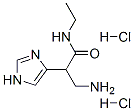
Decarboxy Carnosine HCl: Peptido Anti-Glicacion Resistente a la Carnosinasa
Decarboxy Carnosine HCl (CAS 5765-49-9, beta-alanyl-histamine) es un derivado de carnosina estructuralmente modificado, disenado para resistir la degradacion por la carnosinasa serica (CN1), la enzima que descompone rapidamente la L-carnosina en el tejido humano. Con un peso molecular de 210.24 g/mol, este derivado dipeptidico neutraliza especies carbonilo reactivas — los precursores de los productos finales de glicacion avanzada (AGEs) que causan entrecruzamiento del colageno y amarilleamiento de la piel. TCS NEXUS S.L. suministra Decarboxy Carnosine HCl desde nuestras instalaciones en Valencia, Espana, bajo certificacion FDA cGMP, COSMOS e ISO 45001 para aplicaciones antiedad y de luminosidad cutanea.
Mecanismo de Accion y Datos Clinicos
Glycation occurs when reducing sugars (glucose, fructose, methylglyoxal) react non-enzymatically with lysine and arginine residues on dermal collagen and elastin. These Maillard-type reactions produce AGEs that cross-link structural proteins, reducing skin elasticity and producing a characteristic yellow-brown discoloration. Standard L-carnosine is an effective carbonyl scavenger but has a plasma half-life of only minutes due to rapid hydrolysis by carnosinase CN1.
Decarboxy Carnosine HCl replaces the carboxyl group with a hydrogen, eliminating the CN1 recognition site while preserving the imidazole ring responsible for carbonyl trapping. In a collagen glycation model at 2% concentration, Decarboxy Carnosine HCl inhibited AGE formation by 78%, compared to 63% for equimolar L-carnosine — a 24% relative improvement attributable entirely to sustained activity from enzymatic resistance. An 8-week clinical study (n=30) using a 2% Decarboxy Carnosine HCl serum demonstrated a 22% improvement in skin luminosity scores measured by chromameter. The compound shows dose-dependent anti-glycation activity from 0.5% to 3%, with diminishing returns above 2.5%.
Guia de Formulacion
Decarboxy Carnosine HCl is water-soluble and should be added to the aqueous phase at temperatures below 40C. The recommended use level is 0.5-3%, with 1-2% typical for consumer products and 2-3% for professional treatments. Maintain formulation pH between 4.0 and 7.0; the imidazole ring is most reactive as a carbonyl trap near pH 6.0-6.5.
For targeted anti-glycation serums, combine with niacinamide (3-5%) which independently inhibits the transfer of melanosomes and supports NAD+ metabolism. In anti-yellowing formulations for mature skin, pair with ascorbyl glucoside (1-2%) for complementary antioxidant and brightening activity. Compatible with most cosmetic actives including hyaluronic acid, peptides, and ceramides. Avoid direct combination with strongly acidic actives (glycolic acid below pH 3.5) as this may protonate the histamine moiety and reduce carbonyl-scavenging efficiency. For enhanced anti-aging protocols, consider combining with Carnosine HCl at 1% each for dual-pathway glycation defense.
Preguntas Frecuentes
Por que es Decarboxy Carnosine HCl mejor que la L-carnosina comun?
L-carnosine is hydrolyzed within minutes by carnosinase (CN1) in human serum and skin tissue. Decarboxy Carnosine HCl lacks the carboxyl group that CN1 requires for substrate recognition, making it resistant to enzymatic degradation. This translates to sustained carbonyl-scavenging activity: 78% AGE inhibition versus 63% for L-carnosine at identical 2% concentrations in collagen models.
Que problemas cutaneos aborda Decarboxy Carnosine HCl?
Primarily glycation-driven aging: skin yellowing (sallowness), loss of elasticity from collagen cross-linking, and stiffening of the dermal matrix. The 8-week clinical study showed a 22% improvement in luminosity scores. It is most relevant for formulations targeting mature skin (40+) where cumulative glycation damage is measurable.
Se puede combinar Decarboxy Carnosine HCl con otros peptidos antiedad?
Yes. It is compatible with signal peptides (palmitoyl tripeptide-1, acetyl hexapeptide-8), copper peptides, and other anti-aging actives. Since it works through carbonyl scavenging rather than receptor signaling, there is no competitive inhibition with receptor-mediated peptides. Combining with Carnosine HCl provides both immediate (carnosine) and sustained (decarboxy carnosine) anti-glycation activity.
Cual es la concentracion recomendada para tratamientos profesionales?
For professional anti-glycation peels and treatments, use 2-3%. Consumer leave-on products perform well at 0.5-2%. Activity is dose-dependent with optimal cost-efficiency at 1.5-2% for most applications.
Que certificaciones y MOQ ofrece TCS NEXUS S.L.?
All Decarboxy Carnosine HCl is manufactured under FDA cGMP, COSMOS, and ISO 45001 certification. Evaluation samples start at 1 g for R&D and formulation testing. Production MOQ is 100 g with EU delivery in 5-7 business days from Valencia, Spain.
Especificaciones del Producto
| Parametro | Specification |
|---|---|
| INCI Name | Decarboxy Carnosine HCl |
| CAS Number | 5765-49-9 |
| Chemical Name | Beta-alanyl-histamine dihydrochloride |
| Molecular Weight | 210.24 g/mol |
| Appearance | White to off-white powder |
| Solubility | Water soluble |
| Recommended Use Level | 0.5-3% |
| pH Range | 4.0-7.0 |
| Processing Temperature | Below 40C |
| Certifications | FDA cGMP, COSMOS, ISO 45001 |
| MOQ | 1 g (evaluation), 100 g (production) |
| EU Delivery | 5-7 business days |
Ingredientes Relacionados
- Carnosine HCl — Standard dipeptide anti-glycation agent for immediate carbonyl scavenging
- Ergothioneine — Thione-based antioxidant with complementary radical-scavenging mechanism
- Ectoin — Extremolyte for protein stabilization and osmotic stress protection
Solicitar Decarboxy Carnosine HCl de TCS NEXUS S.L.
Request a 1 g evaluation sample or place a production order (MOQ 100 g) through our site. All orders ship from Valencia, Spain with EU delivery in 5-7 business days. CoA, MSDS, and technical formulation documentation provided with every order. Contact our team for bulk pricing or custom specifications.